

Sign in with
Forget Password?
Learn more
share this!
Share
Tweet
Share
Email
October 1, 2025
by New York University
edited by Sadie Harley, reviewed by Robert Egan
scientific editor
associate editor
This article has been reviewed according to Science X’s editorial process and policies. Editors have highlighted the following attributes while ensuring the content’s credibility:
fact-checked
peer-reviewed publication
trusted source
proofread
Have you ever forgotten about an upcoming doctor’s appointment—only to be reminded the day before by a text from your doctor’s office? People with legal obligations might also forget about upcoming court dates, but the consequences are more dire than a no-show fee. Across America, missed court dates routinely result in warrants and arrests.
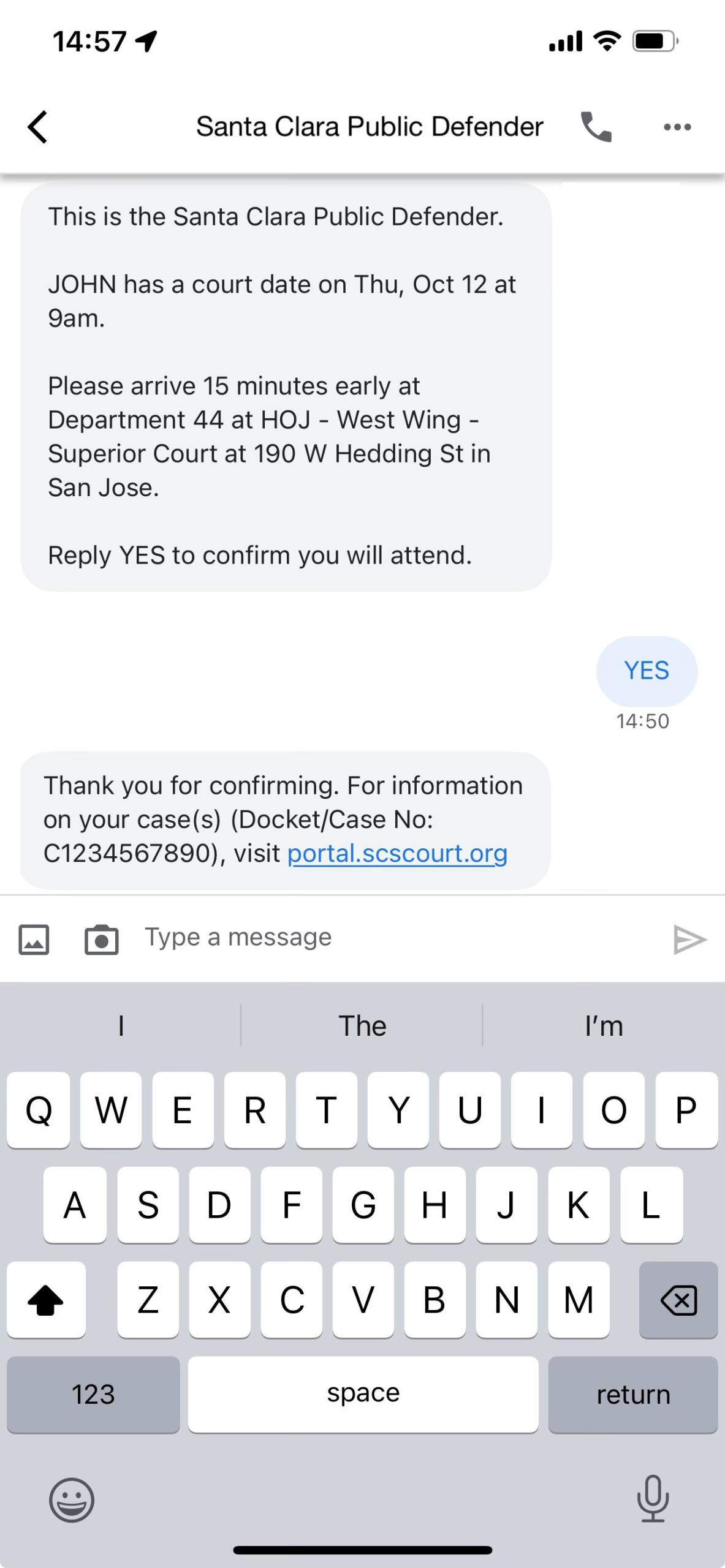
In a new study, published in the open-access journal Science Advances, researchers at NYU, Harvard, and Stanford created software that sent text messages to clients of public defenders in California, reminding them of upcoming court dates. They found that reminders significantly reduced the rates of bench warrants (warrants for arrest following failure to appear in court) and pretrial incarceration.
“It’s remarkable that we can prevent the high costs of pretrial incarceration with text message reminders that cost just a few cents per case,” says lead author Alex Chohlas-Wood, assistant professor of computational social science at NYU Steinhardt.
“This outcome is both great for defendants—who avoid the steep costs of a jail stay—and good for the public at large, which has historically paid the cost of keeping some people in jail simply because they forgot to attend court.”
The research was conducted in partnership with the Santa Clara County Public Defender’s Office in San Jose, California. The researchers randomly assigned 5,709 clients to one of two groups: one group of 2,898 clients who received text message reminders, and a control group of 2,811 who received no messages. The text message group received reminders seven days, three days, and one day before each upcoming court date.
The findings showed that text reminders reduced bench warrants by approximately 20% (12.1% of clients in the control group received warrants compared to 9.7% in the treatment group). Similarly, pretrial incarceration dropped by 21% (6.6% in the control group compared to 5.2% in the treatment group).
The researchers also determined that the impact was similar when looking at clients regardless of whether they had a misdemeanor or felony-level case.
“Our study underscores how interventions that address mental barriers can encourage desired behavior above and beyond the impact of traditional, punitive measures alone. Interventions like these can and should play a vital role in improving the criminal justice system,” says Chohlas-Wood.
More information: Alex Chohlas-Wood, Automated Reminders Reduce Incarceration for Missed Court Dates: Evidence from a Text Message Experiment, Science Advances (2025). DOI: 10.1126/sciadv.adx7483. www.science.org/doi/10.1126/sciadv.adx7483
Journal information: Science Advances
Journal information: Science Advances
Provided by New York University
Explore further
Facebook
Twitter
Email
Feedback to editors
16 hours ago
0
18 hours ago
4
19 hours ago
3
19 hours ago
0
21 hours ago
0
29 minutes ago
3 hours ago
12 hours ago
13 hours ago
13 hours ago
13 hours ago
13 hours ago
13 hours ago
14 hours ago
14 hours ago
11 hours ago
13 hours ago
18 hours ago
Sep 28, 2025
Sep 27, 2025
Sep 26, 2025
More from Art, Music, History, and Linguistics
Oct 26, 2023
Sep 10, 2025
Oct 8, 2020
Jul 9, 2020
Aug 15, 2022
Jul 17, 2024
14 hours ago
18 hours ago
Sep 29, 2025
Sep 26, 2025
Sep 25, 2025
Sep 25, 2025
Text message reminders for court dates led to a 20% reduction in bench warrants and a 21% decrease in pretrial incarceration among public defender clients in California. The effect was consistent across misdemeanor and felony cases, indicating that low-cost reminders can effectively reduce failures to appear in court and associated legal consequences.
This summary was automatically generated using LLM. Full disclaimer
Use this form if you have come across a typo, inaccuracy or would like to send an edit request for the content on this page. For general inquiries, please use our contact form. For general feedback, use the public comments section below (please adhere to guidelines).
Please select the most appropriate category to facilitate processing of your request
Thank you for taking time to provide your feedback to the editors.
Your feedback is important to us. However, we do not guarantee individual replies due to the high volume of messages.
Your email address is used only to let the recipient know who sent the email. Neither your address nor the recipient’s address will be used for any other purpose. The information you enter will appear in your e-mail message and is not retained by Phys.org in any form.
Get weekly and/or daily updates delivered to your inbox. You can unsubscribe at any time and we’ll never share your details to third parties.
More information Privacy policy
We keep our content available to everyone. Consider supporting Science X’s mission by getting a premium account.
Medical research advances and health news
The latest engineering, electronics and technology advances
The most comprehensive sci-tech news coverage on the web