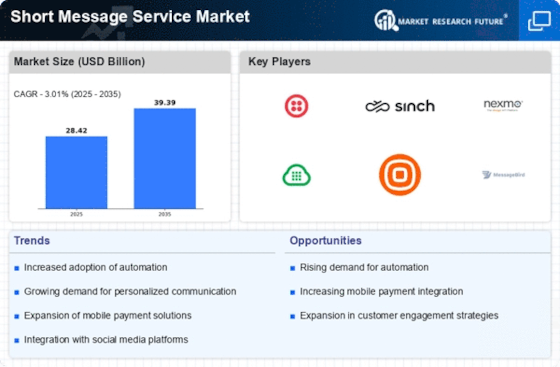
As per Market Research Future analysis, the Short Message Service SMS Market Size was estimated at 28.42 USD Billion in 2024. The SMS industry is projected to grow from 29.28 USD Billion in 2025 to 39.39 USD Billion by 2035, exhibiting a compound annual growth rate (CAGR) of 3.01% during the forecast period 2025 – 2035
The Short Message Service SMS Market is experiencing robust growth driven by technological advancements and evolving consumer preferences.
CAGR
3.01%
Twilio (US), Sinch (SE), Nexmo (US), Plivo (US), Infobip (HR), MessageBird (NL), Vonage (US), Telesign (US), Clickatell (ZA)
The Short Message Service SMS Market is currently experiencing a dynamic evolution, driven by the increasing reliance on mobile communication across various sectors. Businesses are leveraging SMS for customer engagement, marketing campaigns, and transactional notifications, which appears to enhance user experience and foster brand loyalty. Moreover, the integration of SMS with emerging technologies, such as artificial intelligence and machine learning, seems to be reshaping how organizations interact with their customers. This integration potentially allows for more personalized messaging, thereby improving response rates and overall effectiveness. In addition, the Short Message Service SMS Market is witnessing a growing emphasis on security and privacy. As consumers become more aware of data protection issues, companies are likely to invest in secure messaging solutions to safeguard user information. This trend indicates a shift towards compliance with regulatory frameworks, which may further influence market dynamics. Overall, the Short Message Service SMS Market appears poised for continued growth, driven by technological advancements and evolving consumer expectations.
Businesses are increasingly utilizing SMS as a marketing tool to reach customers directly. This trend indicates a shift towards more immediate and personal communication, allowing brands to engage with their audience effectively.
The incorporation of artificial intelligence and machine learning into SMS services is becoming more prevalent. This integration may enhance the personalization of messages, improving customer engagement and satisfaction.
As concerns regarding data privacy grow, there is a notable emphasis on secure messaging solutions. Companies are likely to prioritize compliance with regulations, ensuring that user data is protected.
The Short Message Service SMS Market is witnessing growth driven by the increasing adoption of mobile payment solutions. As consumers become more comfortable with digital transactions, SMS is playing a crucial role in facilitating secure payment confirmations and transaction alerts. In 2025, the mobile payment market is projected to exceed 4 trillion USD, with SMS serving as a vital communication tool for transaction notifications. This integration enhances security by providing users with real-time updates on their financial activities, thereby reducing the risk of fraud. Additionally, businesses are utilizing SMS to send promotional offers and discounts related to mobile payments, further incentivizing consumer participation. The synergy between SMS and mobile payment solutions is likely to bolster the overall growth of the SMS market, as more users embrace the convenience of mobile transactions.
The Short Message Service SMS Market is experiencing a transformative phase with the integration of SMS technology into Internet of Things (IoT) devices. As IoT continues to proliferate, SMS serves as a reliable communication channel for sending alerts and notifications from connected devices. In 2025, it is projected that the number of IoT devices will surpass 30 billion, creating a substantial demand for SMS as a means of communication. This integration allows users to receive real-time updates on their smart home devices, wearables, and industrial equipment, enhancing user experience and operational efficiency. Moreover, businesses are increasingly adopting SMS to facilitate remote monitoring and control of IoT systems, thereby streamlining operations and reducing costs. The convergence of SMS and IoT is likely to redefine communication paradigms, positioning SMS as a critical component in the evolving landscape of connected technologies.
The Short Message Service SMS Market is characterized by an increased focus on customer engagement strategies. Businesses are recognizing the importance of maintaining a direct line of communication with their customers, and SMS has emerged as a powerful tool for achieving this goal. In 2025, it is anticipated that SMS will be utilized in over 60% of customer engagement initiatives across various industries. This trend is driven by the effectiveness of SMS in delivering personalized messages, promotions, and reminders directly to consumers. By leveraging SMS, companies can enhance their marketing efforts and foster stronger relationships with their audience. Furthermore, the ability to track engagement metrics through SMS campaigns allows businesses to refine their strategies and improve overall customer satisfaction.
The Short Message Service SMS Market is experiencing a notable surge in demand for instant communication solutions. As businesses and consumers increasingly prioritize quick and efficient communication, SMS has emerged as a preferred channel. In 2025, the SMS market is projected to reach a valuation of approximately 70 billion USD, reflecting a compound annual growth rate of around 5.5%. This growth is driven by the need for real-time updates, alerts, and notifications across various sectors, including retail, healthcare, and finance. The immediacy of SMS allows organizations to engage with their audience effectively, thereby enhancing customer satisfaction and loyalty. Furthermore, the proliferation of mobile devices has facilitated the widespread adoption of SMS, making it an integral part of communication strategies for businesses worldwide.
The Short Message Service SMS Market is significantly influenced by the expansion of e-commerce and online services. As more consumers turn to online shopping, businesses are leveraging SMS to enhance customer engagement and streamline communication. In 2025, it is estimated that SMS will account for over 30% of all customer interactions in the e-commerce sector. This trend is attributed to the effectiveness of SMS in sending order confirmations, shipping updates, and promotional offers directly to consumers’ mobile devices. The convenience of receiving timely information via SMS not only improves the shopping experience but also fosters brand loyalty. Consequently, businesses are increasingly integrating SMS into their customer relationship management strategies, recognizing its potential to drive sales and improve customer retention.
The Short Message Service (SMS) Market exhibits a diverse application landscape, with Enterprise Messaging commanding the largest market share among its segments. Businesses leverage SMS for internal communications and client interactions, solidifying its position in the market. Meanwhile, Marketing Campaigns are rapidly gaining traction as companies increasingly utilize SMS for direct consumer engagement, leading to a significant uptick in market demand. The ability to connect with customers in real-time enhances the efficacy of marketing strategies, making this segment an attractive area for growth.
Enterprise Messaging (Dominant) vs. Marketing Campaigns (Emerging)
Enterprise Messaging is characterized by its foundational role in business communications, providing a reliable platform for enterprises to engage with employees and customers alike. It has established a dominant position due to its proven effectiveness and cost efficiency. In contrast, Marketing Campaigns are emerging as a key player, utilizing SMS to create tailored promotional strategies that resonate with target audiences. This segment is increasingly recognized for its ability to deliver high engagement and conversion rates, driven by personalized content and timely notifications. As businesses seek innovative ways to attract and retain customers, Marketing Campaigns are poised for significant growth alongside the established dominance of Enterprise Messaging.
In the Short Message Service SMS Market, the BFSI (Banking, Financial Services, and Insurance) sector holds the largest share, underpinned by its critical role in customer engagement and transactions. Retail follows closely, reflecting the increasing reliance on SMS for promotions, updates, and customer service. Other sectors such as Healthcare, Education, and Transportation also contribute but capture relatively smaller shares compared to these leading segments. Growth trends are notably favorable for the Retail sector, which is leveraging SMS for personalized marketing and seamless omnichannel strategies. As businesses seek more efficient avenues for communication, the demand for SMS in sectors like BFSI and Retail is primed to grow, propelled by technological advancements and changing consumer expectations regarding fast, convenient communication channels.
BFSI (Dominant) vs. Transportation (Emerging)
The BFSI sector in the SMS market stands out as a dominant player, capitalizing on its established need for secure, immediate communication for transactions, alerts, and customer service interactions. The sector utilizes SMS to enhance customer experiences, driving loyalty and engagement through timely notifications. In contrast, the Transportation segment is emerging as a significant player, increasingly recognized for its potential to streamline operations and improve customer interactions. Transportation firms are adopting SMS to provide real-time updates, ticketing notifications, and travel alerts, catering to a modern and mobile consumer base. This growing adoption reflects a broader trend across industries towards integrating SMS for enhanced communication and operational efficiency.
In the Short Message Service (SMS) market, the deployment type significantly influences user adoption and satisfaction. Currently, the cloud-based segment holds a dominant position, capturing a major share of the market due to its scalability and ease of integration into existing systems. Organizations increasingly prefer cloud solutions for their flexibility and cost-effectiveness, enabling businesses to manage high volumes of SMS without substantial upfront infrastructure investments. Conversely, the on-premises deployment type is gaining traction, appealing to organizations with specific compliance requirements or data security concerns, making it an emerging choice among certain sectors. The growth trends within the deployment type segment indicate a robust competition between cloud-based and on-premises offerings. The cloud-based solution is largely driven by the rising demand for remote communication solutions, especially in the wake of increased digital transformation efforts across industries. In contrast, the on-premises segment is propelled by organizations seeking to maintain greater control over their messaging services. The evolving regulatory landscape regarding data security is expected to further hasten the growth of on-premises solutions, as organizations prioritize compliance and data privacy in their SMS strategies.
Cloud-based (Dominant) vs. On-premises (Emerging)
In the SMS market, cloud-based deployment stands as the dominant choice, favored by businesses for its ability to provide seamless integration, enhanced scalability, and lower maintenance costs. This model allows organizations to leverage the capabilities of the cloud without significant investments in physical infrastructure. As companies increasingly seek to optimize their communication strategies, the flexibility and accessibility offered by cloud-based services attract a wide range of sectors. On the other hand, the on-premises deployment, while emerging, caters specifically to organizations with stringent security requirements or regulatory compliance needs. These installations provide greater control over data and messaging workflows, appealing to industries where data sensitivity is paramount. Despite being smaller in market share, the on-premises segment’s growth reflects a shifting focus towards tailored solutions for privacy-conscious clients.
In the current landscape of the Short Message Service SMS Market, Promotional SMS represents the largest segment, capturing a significant portion of the overall market share. This type of SMS is widely utilized by businesses to promote products, services, and campaigns, appealing directly to a broad consumer base. Transactional SMS, while smaller in overall share compared to promotional messages, is emerging as a critical component of business communication, ensuring timely information delivery, which is essential for customer engagement.
Promotional SMS (Dominant) vs. Transactional SMS (Emerging)
Promotional SMS stands out as the dominant force in the SMS market due to its extensive use in mass marketing campaigns, allowing brands to reach their audience effectively. These messages are designed to lure potential customers with promotions, offers, and updates, driving consumer interest and sales. On the other hand, Transactional SMS is quickly establishing itself as an emerging segment, essential for real-time communication between businesses and customers. This SMS type serves critical functions such as order confirmations, shipping notifications, and account alerts, leveraging its reliability and immediacy to foster customer trust. Together, they illustrate the diverse applications of SMS in modern marketing and communication strategies.
The Short Message Service SMS Market Market is projected to reach 26.79 USD Billion in 2023, with significant contributions from various regions. North America leads with a valuation of 10.5 USD Billion, showcasing a majority holding in the market due to high mobile penetration and advanced communication technologies. Europe follows closely at 8.0 USD Billion, driven by a robust regulatory framework and widespread adoption of SMS services in various industries. The APAC region, valued at 5.5 USD Billion, highlights a growing mobile user base, contributing to the market growth as mobile services become increasingly affordable.
South America, with a market value of 1.5 USD Billion, demonstrates developing market potential but faces unique challenges such as infrastructure limitations. Meanwhile, the MEA region, valued at 1.29 USD Billion, reflects a growing interest and investment in mobile technology, although it remains the least dominant due to varying levels of economic development and service availability. Overall, these regional dynamics provide critical insights into the Short Message Service SMS Market Market data, capturing trends that can influence future strategies in the industry.
In the Short Message Service SMS Market Market, recent developments indicate a growing trend towards the integration of artificial intelligence and machine learning to enhance SMS communication efficiency. Companies like Twilio and MessageBird are pushing boundaries with innovative features that improve user engagement and analytics capabilities. The market is also witnessing notable mergers and acquisitions, such as Vonage’s strategic acquisition aimed at expanding its communication services portfolio, which boosts its market presence and technological capabilities. Infobip has recently expanded its global reach through partnerships with various telecommunication providers, which is expected to optimize their SMS offerings.
Furthermore, the valuation of players in this sector, including TeleSign and Sinch, has seen significant growth as demand for reliable and scalable SMS solutions rises across enterprises. This growth is complemented by increased requirements for security and compliance, promoting developments around regulations impacting SMS marketing and two-factor authentication.
Meanwhile, initiatives for enhancing customer experience and streamlining messaging solutions remain prevalent, highlighting the competitive dynamics among companies like Clickatell, Plivo, and TextMagic. Overall, the landscape of the SMS market is evolving rapidly, with technological advancements and strategic collaborations shaping its future trajectory.
The Short Message Service SMS Market is projected to grow at a 3.01% CAGR from 2025 to 2035, driven by increased mobile penetration and demand for real-time communication.
New opportunities lie in:
By 2035, the SMS market is expected to solidify its role as a vital communication channel.
The projected market valuation for the Short Message Service SMS Market is expected to reach 39.39 USD Billion by 2035.
The overall market valuation of the Short Message Service SMS Market was 28.42 USD Billion in 2024.
The expected CAGR for the Short Message Service SMS Market during the forecast period 2025 – 2035 is 3.01%.
In 2024, the Enterprise Messaging segment had the highest valuation at 8.0 USD Billion.
The Transaction Alerts segment is projected to reach 7.0 USD Billion by 2035.
The Cloud-based deployment type is expected to dominate the market, projected to reach 22.0 USD Billion by 2035.
The Retail segment is expected to grow to 8.5 USD Billion by 2035.
The Transactional SMS type is projected to have the highest valuation, reaching 14.0 USD Billion by 2035.
Key players in the Short Message Service SMS Market include Twilio, Sinch, Nexmo, Plivo, Infobip, MessageBird, Vonage, Telesign, and Clickatell.
The Healthcare segment is projected to reach 6.0 USD Billion by 2035.
Kindly complete the form below to receive a free sample of this Report
* Please use a valid business email
No regional reports available for this market.
No country-specific reports available for this market.
“This is really good guys. Excellent work on a tight deadline. I will continue to use you going forward and recommend you to others. Nice job”
“Thanks. It’s been a pleasure working with you, please use me as reference with any other Intel employees.”
“Thanks for sending the report it gives us a good global view of the Betaïne market.”
“Thank you, this will be very helpful for OQS.”
“We found the report very insightful! we found your research firm very helpful. I’m sending this email to secure our future business.”
“I am very pleased with how market segments have been defined in a relevant way for my purposes (such as “Portable Freezers & refrigerators” and “last-mile”). In general the report is well structured. Thanks very much for your efforts.”
“I have been reading the first document or the study, ,the Global HVAC and FP market report 2021 till 2026. Must say, good info! I have not gone in depth at all parts, but got a good indication of the data inside!”
“We got the report in time, we really thank you for your support in this process. I also thank to all of your team as they did a great job.”
“The Automotive 48V ECU Components Procurement Intelligence Study” was a complex project, but the Market Research Future (MRFR) team handled it with quality, agility, and customer-centricity. They delivered all requested data on time and within the agreed scope. The team, including Shubhendra Anand and Rahul Gotadki, was always readily available to clarify questions and swiftly implement necessary adjustments, driving the project to a successful conclusion within a very demanding timeframe.
I would also like to specifically commend Akshay Agarwal for his responsiveness and support at every stage—from our initial inquiry on May 6th through to final delivery on June 18th. His dedication made the entire process seamless.”
We do not share your information with anyone. However, we may send you emails based on your report interest from time to time. You may contact us at any time to opt-out.
Kindly complete the form below to receive a free sample of this Report
* Please use a valid business email
Leading companies partner with us for data-driven Insights
Market Research Future (MRFR) is a global market research company that takes pride in its services, offering a complete and accurate analysis with regard to diverse markets and consumers worldwide.

Short Message Service SMS Market Growth, Trends 2035 | MRFR – Market Research Future