

AAPL: 298.87 (4.07)
Copyright © 2026 Quiller Media, Inc. All rights reserved.
· 6 minute read
RCS end-to-end encryption is in beta so it doesn't always work right
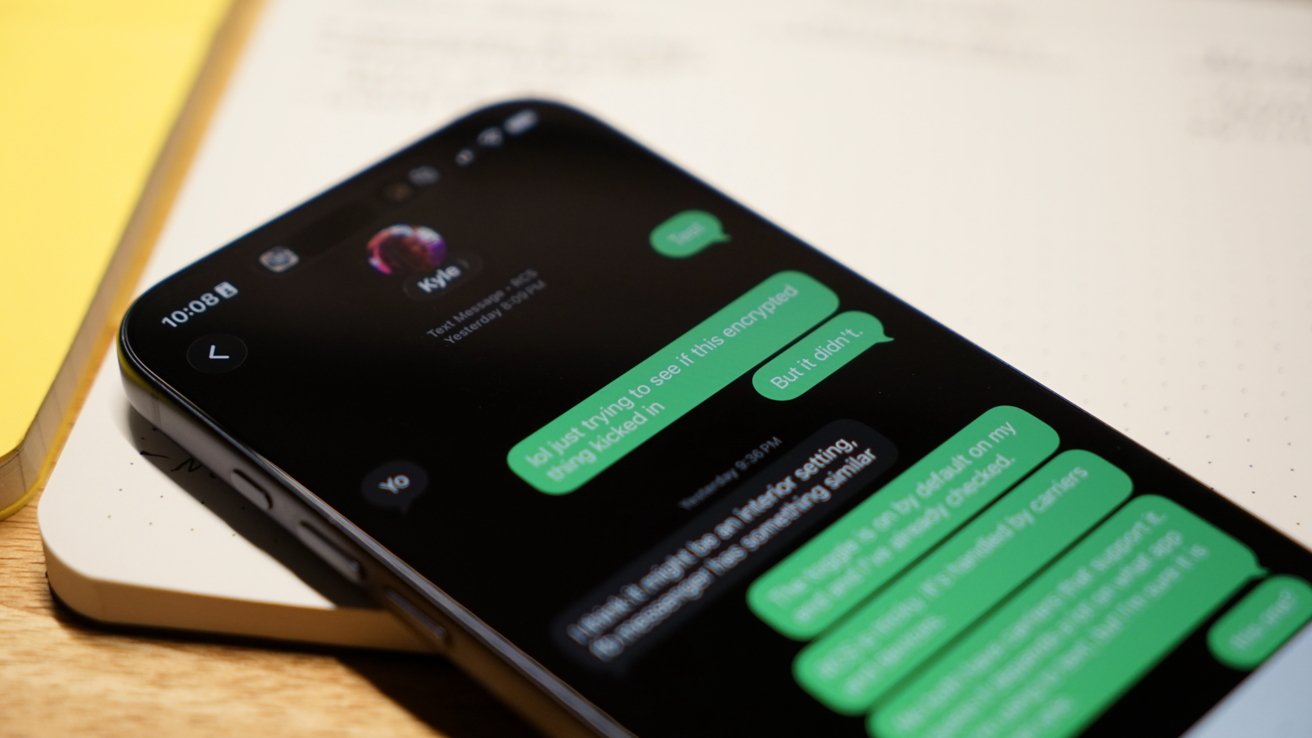
In Messages on iPhone, you can now use SMS, RCS, end-to-end encrypted RCS, and iMessage. Sure, sending media to Android is better, but everything else is more confusing and frustrating than ever.
Sometimes a clever marketing trick or feature highlight can lead to deeply rooted societal divides. What started as a way to show users that they were not using iMessage and potentially being nickeled and dimed for each SMS is now, annoyingly, a kind of status symbol.
The simple act of texting has become a divisive and sometimes irritating aspect of using a smartphone. Whether you care about technology or not, if you’re an iPhone user, you’ve at the least subconsciously reacted to a green bubble text.
For the Android user, it’s a different story. When they text an iPhone user, most of the time it feels like texting anyone. Then there’s the double text, a “sent with balloons,” or “Wesley liked that text” that intrusively shoves itself into the chat.
There’s got to be a better way.
RCS is the bastard child of internet protocol messaging that is still somehow tied to carriers. It is a dumb idea that climbed to the top of dumb ideas and won out as the most suitable dumb idea.
RCS has been slowly accumulating new features
The concept: “Let’s replace the ancient SMS protocol controlled by carriers with a new one still controlled by carriers.”
Thankfully, the protocol is better. Some reactions actually show up as expected on the Android user’s chat, images are no longer potato quality, and you can actually send a 4K video.
The thing is, it only made things more complicated and frustrating for the end user, especially for those on iPhone.
Now, not only do you need to pay attention to what kind of message it is, green or blue, you have to know if it’s SMS or RCS. iOS 26.5 throws in another wrinkle — end-to-end encryption.
We’ve gone from two potential endpoints to four. Great work, team.
Image source: XKCD comic ‘Standards’
Not only that, but this “beta” feature for E2EE seemingly breaks RCS chats for some users. This is likely out of Apple’s hands and more of a carrier/device issue.
When using RCS, you have to consider the device each person is using, the software version, the carriers in use, and whether or not end-to-end encryption has been enabled.
You don’t have that problem with iMessage. It just works.
There was once this idea that Apple could flip a switch and bring iMessage to Android whenever it felt like it. That they were greedily just keeping it exclusive for customer lock-in.
iMessage continues to hold blue bubbles as superior
There’s some truth to the latter, but the former is definitely not accurate. Maybe iMessage was a much less complex service at the start, even with its end-to-end encryption.
But once the Secure Element and biometrics got involved, iMessage became more dependent on what hardware was involved in the conversation.
Perhaps Apple could bring iMessage to just select Android phones with things like Samsung Knox or Pixel’s version of the Secure Element. But that would create yet another complexity and annoyance layer for users to overcome.
Google spent years blaming Apple for the fracture in messaging protocols. However, if you examined the situation, it was the other way around.
Cross platform messaging with native applications shouldn’t be this complicated
If Google had bothered to implement similar systems in early Android, it would have had a competitive and dominant internet messaging protocol. Instead, it has an ecosystem where users can have three separate apps installed for SMS by default.
I don’t want a less secure iMessage that’s more open, nor do I want a carrier-controlled protocol that’s fractured and complicated. Apple had no interest in developing a separate protocol that could ultimately supersede iMessage, but Google obviously did.
But it never bothered. Google has its messaging app, sure, but it doesn’t compare in features or implementation to Apple’s.
It isn’t as if Google didn’t have the money and engineering talent to build a killer universal chat app. It just chose not to for whatever reason.
Look at Meta’s Facebook Messenger app. It’s annoyingly complicated and insecure, but it exists and is very popular.
All Google needed to do was come up with Android’s version of iMessage, but also include it on iPhone, and it could have dominated the market. But there’s no ad revenue or financial incentive to do so.
Googlebook brings AI to your cursor
Look at Google’s recent Android event where it announced a bunch of AI tools no one asked for and a “Googlebook” that’s a tragic merging of ChromeOS and Android. Just shake your mouse, and AI will pop up! No thanks.
There’s another reason Google didn’t bother with a new cross-platform messaging app. It is likely the same reason Apple didn’t attempt it either – it’s not easy.
The Android ecosystem is just too fractured to build a secure software stack with expectations of minimum performance and security features across devices. There are just too many variables to account for in Android.
I have a lot of group chats, and most of them are iMessage-based. A couple, more recently, have Android participants.
Add one Android user to a previous iMessage group chat and this is a lot of your experience
Having Android users as friends isn’t a bad thing. I want them to be included, but it has added some pain points.
Every few messages, it says “you’ve renamed this chat.” I’ve also encountered a bug that says my message can’t be sent.
It just fails and fails, and I just have to wait until it doesn’t. That was present in iOS 26.4 and will likely get worse with iOS 26.5.
Our group chat names and images stuck, so that’s nice. But if we use any reaction beyond the couple chosen by RCS, it shows up as “person reacted with emoji.”
iPhone 17e makes it easy to switch from Android, but price isn’t always the issue
We also can’t utilize some iMessage-specific features like polls.
RCS is many steps above SMS, absolutely. I’ve even turned off SMS fallback and MMS messaging to ensure I’m only using RCS.
I’m not personally invested in how these things work on Android devices. Those people bought those devices for whatever reason, and they can live with whatever the group chat looks like.
Of course, I’d love to see Google improve that aspect too, but it feels unlikely. They just don’t seem to care.
Apple, on the other hand, should do some of its usual magic to improve interacting with Android users. It would satisfy their demand for feature exclusivity and lock-in too.
RCS is still being worked on so things could get better
Basically, what I want is Apple’s Messages app to intelligently manage any chat involving RCS or SMS. Place reactions appropriately and don’t show the “person reacted with emoji” message. Same goes for message effects, etc.
Polish off the rough edges and make the chat feel more natural. We already have an iPhone, so there’s no need to convince us by making the green bubbles a worse experience.
On a side note, Apple should bring more apps to Android so sharing Apple features isn’t so awkward. We have Shared Photo Albums in Photos for our group chats, but the Android users can’t participate.
Apple Invites on Android goes through a browser. Other links to Apple services are basically useless.
At least Android has Apple Music and Apple TV. But it should have Apple Podcasts, Apple Maps, and Apple Photos.
Apple should make messaging all platforms good even if Google doesn’t
Imagine SharePlay with Android users via Apple apps. Apple could introduce those other apps as a way to give Android users a taste of what they might be missing on iPhone.
Apple has nothing to worry about. If anything, it might gain some paying customers.
Such a change might even help reduce the social problems like bullying for green bubbles. If the experience is less bad, but still not as good as iMessage, it’s a win-win.
I’m happy that RCS exists and it is moving towards universal end-to-end encryption. I just wish this whole thing wasn’t so finicky.
No one should ever think about what chat protocol they are using in 2026, yet Apple’s green/blue bubbles do exactly that. There should be a change.
Wesley was in the US Navy for ten years, serving as a carrier-based nuclear trained electrician, then jumped careers in 2019. Today, he is Assistant Editor, Podcast Cohost, SEO Specialist, and Social Media Manager for…
Does anyone actually think this matters? Why anyone would want to expose their devices to Google’s lack of security and mining of your personal data? All this discussion about a bubble? It’s beyond ridiculous.
I nearly never comment but I am so sick of all technical blogs clearly not understanding the reason or providing education for the green vs. blue.
BLUE means it is traveling via a data connection through Apple technology and uses WiFi or a cellular data SIM purchased for the country you are in.
For anyone that travels international and received an SMS though a cellular carrier while roaming this in a major irritation and expensive.
GREEN means if you are roaming or traveling international it will cost you. (Cellular provider relays the communications, SMS not encrypted)
Tech blogs need to better educate. This is intentional and not an Apple conspiracy. STOP THE CRAP AND EDUCATE!
Or, I don’t know use WhatsApp, Signal, or whatever. You have plenty of options. SMS and RCS are both cellular carrier standards to ensure they can charge you for roaming and international when ever your plan doesn’t include international or roaming.
AppleInsider said:In Messages on iPhone, you can now use SMS, RCS, end-to-end encrypted RCS, and iMessage. Sure, sending media to Android is better, but everything else is more confusing and frustrating than ever.
Now, not only do you need to pay attention to what kind of message it is, green or blue, you have to know if it’s SMS or RCS. iOS 26.5 throws in another wrinkle — end-to-end encryption.
Maybe iMessage was a much less complex service at the start, even with its end-to-end encryption.
But once the Secure Element and biometrics got involved, iMessage became more dependent on what hardware was involved in the conversation.
Perhaps Apple could bring iMessage to just select Android phones with things like Samsung Knox or Pixel’s version of the Secure Element. But that would create yet another complexity and annoyance layer for users to overcome.
Of course, I’d love to see Google improve that aspect too, but it feels unlikely. They just don’t seem to care.
With E2EE RCS not even out of beta on your iPhone, you’re already declaring it terrible, horrible, no good, very bad? 🙂
1. So you say Google just doesn’t care. If it were not for Google creating an equally secure and seamless first-party messaging system safe from pying eyes on Android, the carriers would still be in control of your data as soon as a non-an-iPhone becomes part of the communication string, or circumstances forced it to be sent SMS rather than through Apple servers. Until now both platforms have been relying on their own servers to ensure security. Apple secured iMessage and Google secured Google Messages at their expense. That changes now.
2. Without Google there would be no MLS protocol in RCS, and no encryption in the standard. Google forced the issue, and late in the game Apple came on board. Yay. The carriers didn’t want to secure it, and for marketing reasons Apple didn’t care, but they couldn’t block Google’s efforts. The carriers abandoned their own messaging apps and servers and decided probably Google knew best. With E2EE now part of the carriers official standard, communications will only become more secure and private, not less.
3. In the US there will be nothing confusing about RCS, when or where or how to employ it. It’s a false premise that users will have to choose how to send their messages. Cross platform it will be RCS, and in the United States it will E2EE RCS by default going forward. Carriers big and small are already on board supporting RCS E2EE, so no roadblocks in the US, and with rare exception Canada
4. Overseas or outside the US, iMessage is just a bit player anyway for the msot part. I believe E2EE RCS (4.0 is already certified) will be making a bigger impact whether on Android or integrated with other messaging services. Carriers are already prepped for it, so sooner rather than later the old versions of RCS will disappear. https://support.apple.com/en-us/109526
5. Somehow the other app users aren’t confused or bewildered, so why would the smarter iOS users? iMessage may become less of a draw to the platform, but that’s something for Apple to deal with, not the end-user.
6. If you have an iPhone and iMessage you will have to update to the latest OS version. Weirdly it appears there’s millions of iPhones stuck somewhere in the past. My father and mother-in-law never have never updated their iPhones, and comments in other forums indicate that is not particularly unusual. The updates may have been delivered, but not necessarily installed. Yes, that a problem, but not of RCS making. If you have an Android phone and Google Messages it was likely already updated for secure RCS some time ago, and will receive an app update once Apple’s RCS comes out of beta. Encryption via MLS is the default just as on your iPhone.
7. Finally, what green bubble problems? Apple chooses colors, and the reasons for them. It won’t affect Android security and privacy no matter what color it is. If the message is tagged E2EE RCS on your end it will be tagged the same on the receivers side whether that another iPhone or an Android phone. Simple. If you are confused, Apple can more clearly and loudly explain what blue and green mean, and that’s entirely up to them to do so. Increasingly it won’t mean anything to anyone outside of Apple’s ecosystem, so no reason to sing to that choir. They will have their own message colors for their own message apps, and do.
In Messages on iPhone, you can now use SMS, RCS, end-to-end encrypted RCS, and iMessage. Sure, sending media to Android is better, but everything else is more confusing and frustrating than ever.
Now, not only do you need to pay attention to what kind of message it is, green or blue, you have to know if it’s SMS or RCS. iOS 26.5 throws in another wrinkle — end-to-end encryption.
Maybe iMessage was a much less complex service at the start, even with its end-to-end encryption.
But once the Secure Element and biometrics got involved, iMessage became more dependent on what hardware was involved in the conversation.
Perhaps Apple could bring iMessage to just select Android phones with things like Samsung Knox or Pixel’s version of the Secure Element. But that would create yet another complexity and annoyance layer for users to overcome.
Of course, I’d love to see Google improve that aspect too, but it feels unlikely. They just don’t seem to care.
Read on AppleInsider
mwschaf said:Does anyone actually think this matters? Why anyone would want to expose their devices to Google’s lack of security and mining of your personal data? All this discussion about a bubble? It’s beyond ridiculous.
Viola, E2EE RCS is coming for your iPhone. Neither carriers, the gub’ment, Google or Apple will be able to read your messages….
Unless you’re so uninformed that you think opting out for SMS will make things safer for you. Don’t be that guy that makes messages insecure for everyone
Excellent article and correct on all accounts. IMessage is the quintessential Apple ‘it just works’ app.