
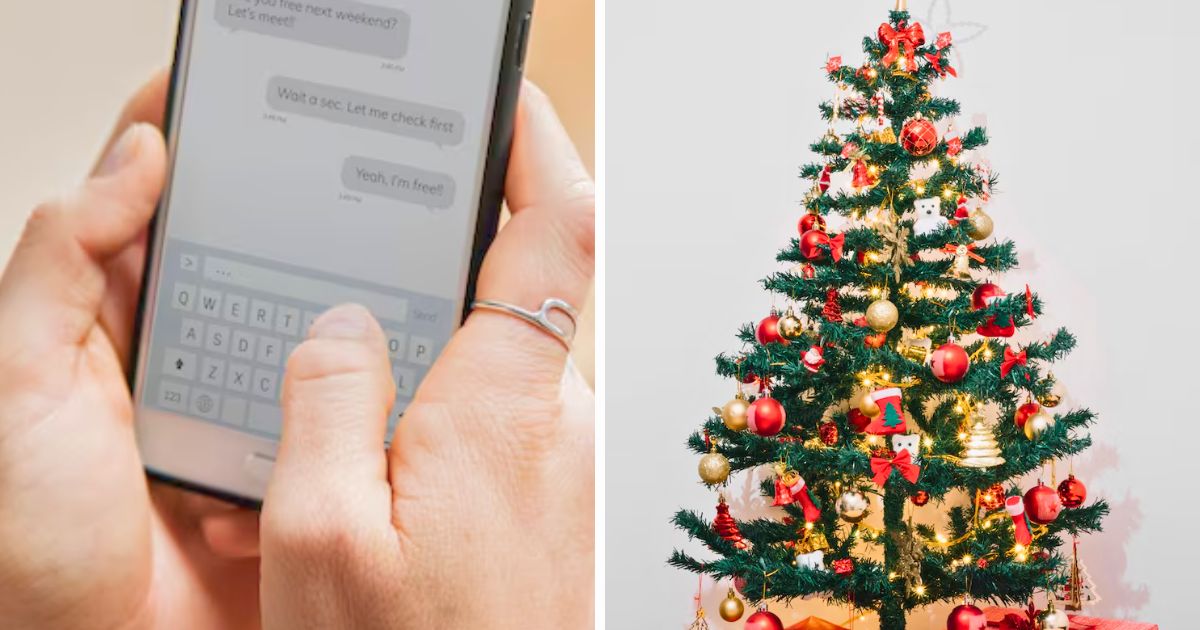

Big things can surely come in tiny packages, and that started with a 160-character limit on your phone. The world’s first SMS was a wholesome but simple “Merry Christmas,” sent on 3 December 1992. Neil Papworth, a 22-year-old Vodafone engineer, was conducting some testing via his phone when he accidentally changed human communication forever.
The recipient of this message was Richard Jarvis, one of Vodafone’s bosses, who didn’t even text back.
To be fair, the reason could also have been that his phone was an Orbitel 901 and weighed 2.1 kilograms! That’s the equivalent of 12 iPhone 14s, just to give a real-world comparison point. Still, when Jarvis received the world’s first text, he had no idea that it would bloom into a global addiction that would eventually reach nearly every phone.
3 December 1992. Neil Papworth sent the world’s 1st mobile phone text message. It read: “Merry Christmas.” It was sent to the cellphone of Vodafone director, Richard Jarvis. It was a modest start, but it ultimately changed the way in which humans communicated with each other. pic.twitter.com/5NnU8OVPNN
— Prof. Frank McDonough (@FXMC1957) December 3, 2025
SMS (which actually expands to Short Message Service) was initially designed to squeeze 160 text characters into a phone signal. And if you didn’t live through the pre-T9 era, we really hope you know that typing the letter C required pressing “1” three times. Modern typers who use swipe typing or voice typing would have cried, honestly. In 1993, Nokia gave phones a signature beep to alert users to a new SMS, and this sound would eventually spark millions of messages worldwide.
In 1999, networks finally allowed cross-network texting instead of keeping messages trapped inside the same carrier. By 2002, people had sent 250 billion texts globally. In 2010, “texting” officially entered the Oxford English Dictionary. After that came acronyms like LOL, BRB, FYI, and IDK, which have now ventured into Gen Alpha territory—so let’s just leave it there. What we know is that since then, texting has become the blueprint for how we now communicate. Fast, that’s all.
Then came smartphones, as Apple introduced the iPhone in 2007, and suddenly messaging included pictures. The Snapchatification of practically every social media app followed. In 2012, the UK logged 150 billion SMS messages, but that dropped to 40 billion in 2021. Why did that happen? Messaging had mutated. Now, WhatsApp, iMessage, and others dominate our phones, and reportedly 100 billion WhatsApp messages are sent around the world every single day. Can you believe that?
WhatsApp users:
1. 🇮🇳 India: 549.9 M
2. 🇧🇷 Brazil: 148 M
3. 🇮🇩 Indonesia: 112 M
4. 🇺🇸 USA: 100 M
5. 🇵🇭 Philippines: 88 M
6. 🇲🇽 Mexico: 77 M
7. 🇷🇺 Russia: 66.7 M
8. 🇹🇷 Turkey: 60 M
9. 🇪🇬 Egypt: 56 M
10. 🇵🇰 Pakistan: 52 M
Source: Statista, 2024-2025
— World of Statistics (@stats_feed) November 28, 2025
Coming back to the trusty old SMS, today the NHS uses it for appointment reminders. Banks and tech companies use it for two-factor log-ins. Charities have “text to donate” campaigns, with one of the biggest ones during Super Bowl XLII in 2008. Politics joined in, too, as in 2008, Barack Obama announced his vice-presidential pick via text! Phones have witnessed history since.
RELATED: Kristi Noem Warned Her Texts Are Now Evidence as Trump Admin Braces for Court Showdown
Your email address will not be published.
Sign in to your account