

Credit: Shutterstock
Read in this series
In this context, each Company should determine within SMS the period and intervals of Master’s Review. Most of the Companies require that Master provide a feedback on SMS once per contract, meaning that during his contract, the Master has to send at least one SMS Review report.
However, a key question arises: Is this frequency sufficient enough for constructive feedback with respect to ISM compliance on board? Therefore, companies may need to consider additional guidance for this specific timeframe.
A different approach
A best practice could be to request from Master to provide feedback from SMS performance after implementing it on board for one or two months since employment. This may provide the following benefits:
Different mentality is needed
What often goes with the ISM Code, is the constant complaining about the additional paperwork that burdens crew members’ work onboard, resulting in complex procedures. However, when the time comes for providing feedback through SMS review, the company usually receives a blank page of recommendations. This probably has a deeper cause, as many Masters may be afraid of their position within the Company and their future contacts, and so they choose not to “Poke the bear”.
Nonetheless, this not the general idea of SMS and furthermore of the ISM Code as this certainly gives no room for improvements. On the contrary, the ISM Code attempts to involve all participants (ashore and on board) in the effective implementation through the implementation of the Company’s policies as included in SMS.
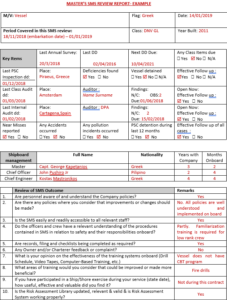
Master’s SMS Review report: Key items
A Master’s SMS Review report should include at least the following items:
In addition to the above, the DPA is the responsible person to accept, review and take action after receiving Master’s SMS review. Each item should be considered as standalone and compared with other feedback from previous or other fleet Masters.
Needless to note that each received SMS review should be answered formally (through official communication lines between Company and ship). All items should be addressed and any feedback should be attached with the review report and kept on board by the Master as evidence of the effective ISM and SMS implementation.
The Master’s SMS review should not relieve the Company responsibility to maintain constant closed loop communication between the management ashore and the ship. The Company has responsibility to determine the gaps between work as planned through SMS manuals and work as done, both ashore and afloat. It is the Company responsibility to develop safe “work environment”, which provides psychological safety for candor.
This probably has a deeper cause, as many Masters may be afraid of their position within the Company and their future contacts, and so they choose not to “Poke the bear”. — In case of third world countries Masters surely yes, they are very afraid of everything.
All policies are only for perfect life which never will happens.
The main important thing is to be followed, and the one, only to be aimed to reach must be situational awareness and good communication between departments on board and with the company.
With the experiences gained with the lifetime of the company minimum required spares and critical equipment on board list to be updated and must be followed properly.
Your email address will not be published.
© 2025 SAFETY4SEA
© 2025 SAFETY4SEA
© 2025 SAFETY4SEA