The company cites its own statistics and external assessments: according to Google data, a YouGov survey, and research by Counterpoint and Leviathan, Android users are less likely to receive fraudulent SMS and calls, and Pixel demonstrates the highest protection by default.
The company cites its own statistics and external assessments: according to Google data, a YouGov survey, and research by Counterpoint and Leviathan, Android users are less likely to receive fraudulent SMS and calls, and Pixel demonstrates the highest protection by default.
The security platform is described on the Google Security blog, where the company provides key figures and methods for combating scams. Over the past 12 months, the Android ecosystem has filtered over 10 billion suspicious calls and messages every month, and in RCS, the team cuts off over 100 million suspicious numbers from the service every month before they even attempt to send messages.
Google cites YouGov surveys in the US, India and Brazil: Android users were more likely to report no fraudulent SMS messages in a week, with Pixel owners showing an even greater advantage over iPhone owners. Android users were also more likely to rate the built-in protection as «very effective» or «extremely effective.»
Independent assessments reinforce Google’s findings. Counterpoint Research compared current Android devices and iPhones and found greater use of AI on Android across ten key security areas, from email and web browsing to on-device behavioral analytics. Leviathan Security Group’s own test found the Pixel to have the highest default protection, followed by other flagship Android models, and then the iPhone.
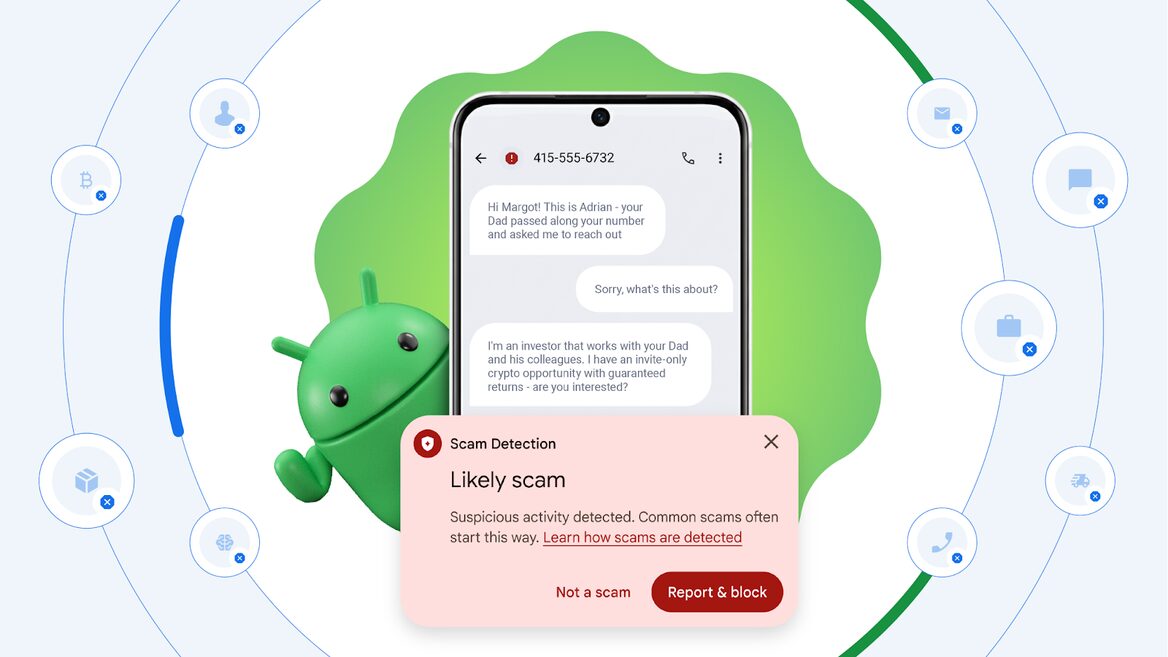
Technically, protection works on several levels. In Google Messages, unknown callers and suspicious texts are automatically sent to Spam & Blocked, and built-in fraud detection on the device analyzes conversation patterns like «pig butchering» and warns in real time. The Phone app has automatic blocking of known spam, Call Screen, and in-call prompts; Android also blocks high-risk actions during a call, such as attempts to install untrusted apps or turn off protection.
An additional factor is Play Protect with real-time app checks and Safe Browsing in Chrome based on large language models, which reduces the risk of phishing and malware installation. All critical checks for call and message warnings are performed locally and do not store the content of conversations.
According to industry organizations, losses from mobile fraud worldwide exceed hundreds of billions of dollars per year, and attackers are increasingly using generative AI to imitate voices, writing styles, and «persuasive» scenarios. Against this backdrop, Google is promoting a strategy of proactive, multi-layered protection at the system and service levels, emphasizing fraud detection before contact with the user and warnings during interaction.
Previously, dev.ua wrote about how Instabug created a tool called SmartResolve, which uses AI models to find the causes (and potential fixes) of bugs in apps on Apple’s iOS and Google’s Android. It turned out that all AI models, including Gemini, do this job better on iOS.
Have important news to share? Message our Telegram bot
Key events and useful links in our Telegram channel

Google claims Android is better at protecting against mobile fraud than iPhone – dev.ua