

This is read by an automated voice. Please report any issues or inconsistencies here.
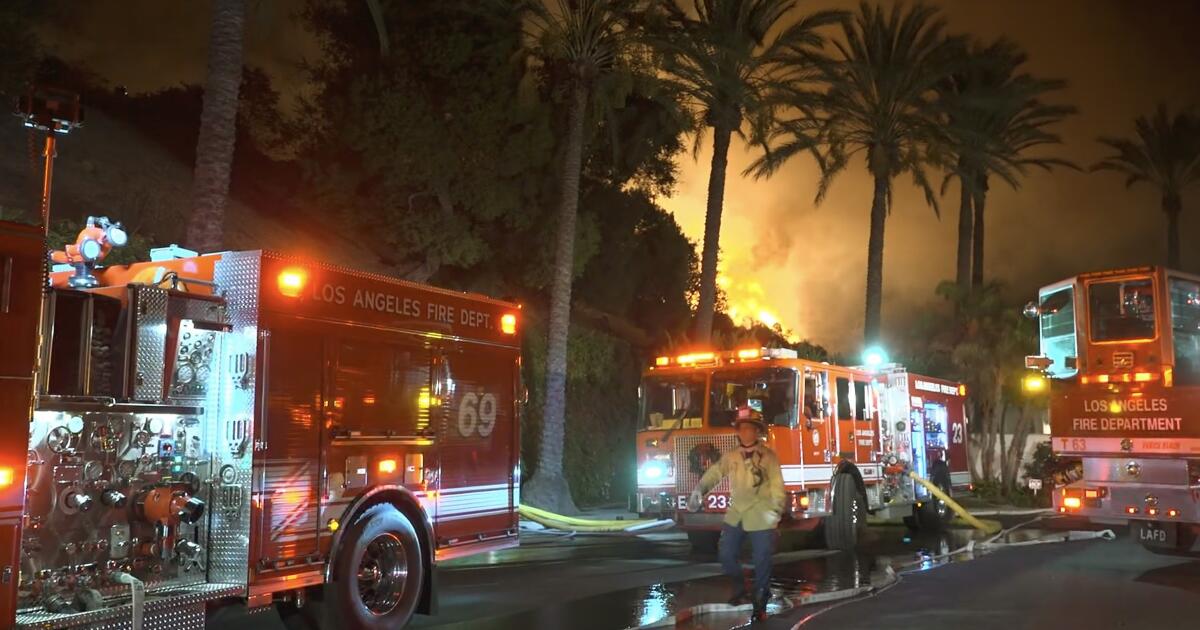
A federal grand jury subpoena has been served on the Los Angeles Fire Department for firefighters’ text messages and other communications about smoke or hot spots in the area of the Jan. 1 Lachman brushfire, which reignited six days later into the massive Palisades fire, according to an internal department memo.
The Times reported last week that a battalion chief ordered firefighters to pack up their hoses and leave the burn area the day after the Lachman fire, even though they complained that the ground was still smoldering and rocks were hot to the touch. In the memo, the department notified its employees of the subpoena, which it said was issued by the U.S. attorney’s office in Los Angeles.
“The subpoena seeks any and all communications, including text messages, related to reports of fire, smoke, or hotspots received between” 10 p.m. on New Year’s Eve and 10 a.m. on Jan. 7, said the memo, which was dated Tuesday.
California
Texts between three firefighters and a third party reveal previously undisclosed details about the Los Angeles Fire Department’s handling of a Pacific Palisades burn site.
A spokesperson with the U.S. attorney’s office declined to confirm that a subpoena was issued and otherwise did not comment. The memo did not include a copy of the subpoena.
The memo said the subpoena was issued in connection with an “ongoing criminal investigation” conducted by the Bureau of Alcohol, Tobacco, Firearms and Explosives.
Last month, an ATF investigation led to the arrest of former Pacific Palisades resident Jonathan Rinderknecht, who was charged with deliberately setting the Jan. 1 fire shortly after midnight near a trailhead.
It is unclear from the memo whether the subpoena is directly related to the case against Rinderknecht, who has pleaded not guilty.
During the Rinderknecht investigation, ATF agents concluded that the fire smoldered and burned for days underground “within the root structure of dense vegetation,” until heavy winds caused it to spark the Palisades inferno, according to an affidavit attached to the criminal complaint against Rinderknecht.
The Palisades fire, the most destructive in the city’s history, killed 12 people and destroyed thousands of homes, businesses and other structures.
Last week, The Times cited text messages among firefighters in reporting that crews mopping up the Lachman fire had warned the battalion chief that remnants of the blaze were still smoldering.
The battalion chief listed as being on duty the day firefighters were ordered to leave the Lachman fire, Mario Garcia, has not responded to requests for comment.
In one text message, a firefighter who was at the scene on Jan. 2 wrote that the battalion chief had been told it was a “bad idea” to leave because of the visible signs of smoking terrain, which crews feared could start a new fire if left unprotected.
“And the rest is history,” the firefighter wrote in recent weeks.
California
Jonathan Rinderknecht is accused of intentionally starting fire that destroyed Pacific Palisades.
A second firefighter was told that tree stumps were still hot at the location when the crew packed up and left, according to the texts. And a third firefighter said last month that crew members were upset when told to pack up and leave but that they could not ignore orders, according to the texts. The third firefighter also wrote that he and his colleagues knew immediately that the Palisades fire was a rekindle of the Jan. 1 blaze.
The Fire Department has not answered questions about the firefighter accounts in the text messages but has previously said that officials did everything they could to ensure that the Lachman fire was fully extinguished. The department has not provided dispatch records of all firefighting and mop-up activity before Jan. 7.
After The Times published the story, Mayor Karen Bass directed interim Fire Chief Ronnie Villanueva to launch an investigation into the matter, while critics of her administration have asked for an independent inquiry.
The most important California stories and recommendations in your inbox every morning.
By continuing, you agree to our Terms of Service and our Privacy Policy.
Follow Us
Alene Tchekmedyian is an investigative reporter at the Los Angeles Times. She previously covered the Los Angeles County Sheriff’s Department, focusing on accountability stories and writing about failures by officials to comply with transparency laws. Before joining The Times in 2016, she reported on crime and policing for the Glendale News-Press and Burbank Leader.
Follow Us
Paul Pringle is a former Los Angeles Times reporter who specialized in investigating corruption.
California
California
Climate & Environment
Climate & Environment
Why is California’s wildfire strategy wrong for SoCal? After massive blazes, the state changed its approach, but it only works for the north. Listen to find out what officials are doing wrong — and the surprising strategy they’re turning to next.
In 1990, UCLA student Ronald Baker was murdered in a railway tunnel. While his occult interests fueled “Satanic Panic” rumors, police found his killers knew him well — one had even carried his casket.
A gunman targeted an elementary school in Rancho Tehama after a deadly rampage. The media barely covered it. Five years later, an L.A. Times reporter wants to know why.
California
California
California
California
Subscribe for unlimited access
Site Map
Follow Us
MORE FROM THE L.A. TIMES