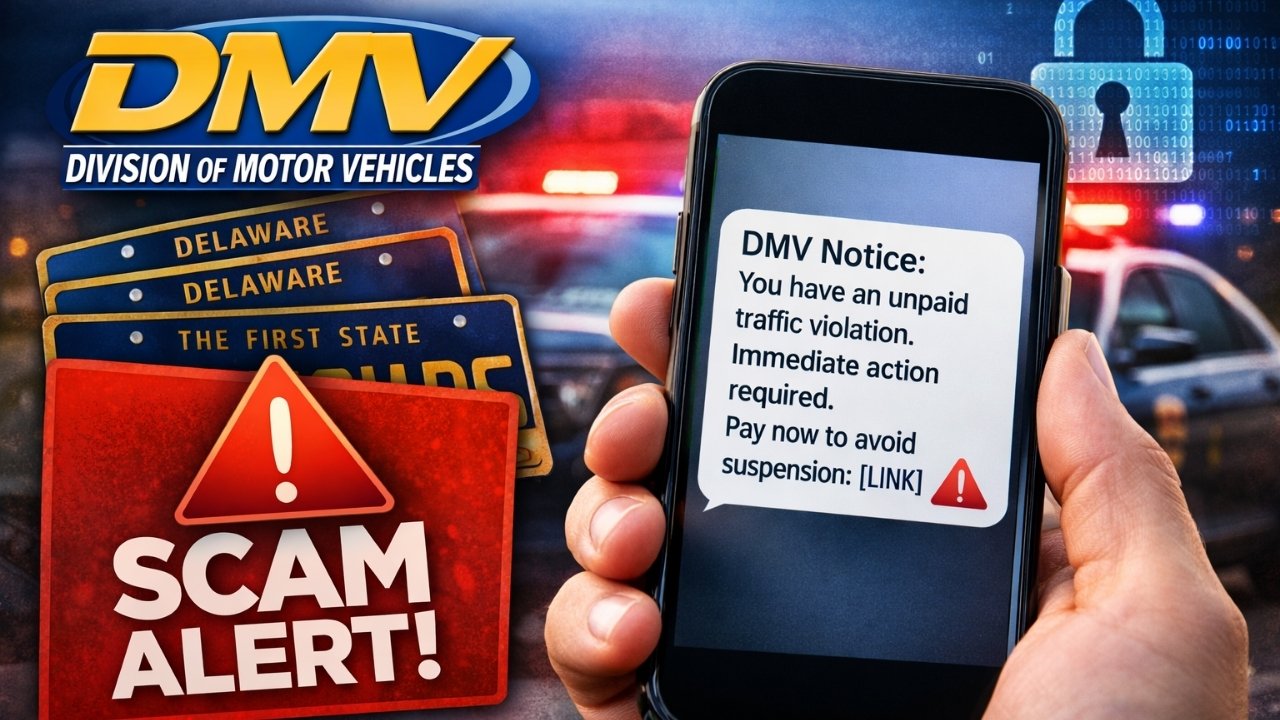
The Division of Motor Vehicles has issued a public warning after reports of a new text-message scam circulating among residents. The fraudulent messages falsely claim to be from the DMV and allege that the recipient has an unpaid traffic or toll violation requiring immediate payment.
According to officials, the scam uses SMS texts to pressure recipients into clicking a payment link, warning that failure to act could result in penalties such as vehicle registration suspension. Authorities say the messages are designed to provoke panic and quick compliance.
The DMV has confirmed that these texts are not legitimate. The agency emphasized that it does not request payments or personal information through text message links and urged the public to remain cautious.
Officials report that the scam is delivered via Short Message Service (SMS), a channel frequently exploited due to its high open rate. The messages often appear brief and authoritative, mimicking the tone of official government notifications.
In many cases, the texts lack specific identifiers such as a citation number, license plate, or full legal name. This allows scammers to distribute the same message broadly, regardless of whether the recipient has any actual violations on record.
Authorities note that the message’s simplicity is intentional, as it minimizes scrutiny while maximizing the likelihood of an immediate response.
The DMV has warned that clicking the link embedded in these scam messages can expose users to significant risks. Some links redirect victims to imitation payment portals designed to collect credit card details, addresses, and contact information.
In other instances, the link may attempt to access data stored on the phone, potentially exposing saved passwords or personal files. Officials say this type of data theft can lead to identity fraud extending well beyond the initial interaction.
Cybersecurity specialists note that SMS-based phishing campaigns are often part of larger networks that reuse stolen data for multiple fraud attempts.
Government agencies are frequently impersonated because they carry legal authority and public trust. The DMV, which oversees licensing, registration, and enforcement, is particularly effective at covering up scam operations.
Traffic fines and toll payments are common experiences for drivers, reducing skepticism when such claims appear unexpectedly. Officials also point out that increased use of online government services has made it easier for criminals to convincingly imitate legitimate payment systems.
This combination of authority, familiarity, and urgency has made DMV-themed scams increasingly common nationwide.
Despite appearing official, investigators say these messages share consistent indicators that distinguish them from legitimate DMV communications.
Authorities reiterated that neither the DMV nor EZ-Pass uses SMS links to collect payments.
DMV Director Amy Anthony cautioned that scammers rely on emotional reactions. She advised residents to slow down and verify any claims before taking action.
Officials recommend accessing DMV services only by typing the official website address directly into a browser or by contacting the agency using verified phone numbers. This approach reduces the risk of being redirected to fraudulent sites.
The DMV has also encouraged residents to share scam warnings with family members and older adults, who may be more vulnerable to digital fraud.
Understanding standard DMV practices can help residents quickly identify suspicious messages. The table below compares legitimate DMV communication methods with common scam tactics.
Officials stress that legitimate notices always provide time for review and multiple ways to verify authenticity.
Residents are advised not to respond to suspicious messages or click any links. Engaging with the sender can confirm that a phone number is active and invite additional scam attempts.
If a link has already been clicked, officials recommend monitoring financial accounts, changing passwords associated with sensitive services, and running a security scan on the device. Reporting the message to consumer protection authorities can also help track emerging scam trends.
Text-message phishing, commonly referred to as “smishing,” has increased as mobile payments and digital government services expand. SMS messages are often perceived as more trustworthy than emails, making them an effective tool for scammers.
Government impersonation remains one of the most frequently reported scam categories. Officials emphasize that awareness and verification remain the most effective defenses against these schemes.
Do not click any links or reply to the message. Verify the claim by visiting the official DMV website directly or contacting the agency through verified channels.
No. The DMV does not use SMS links to collect payments or request personal information.
Yes. Clicking the link alone may expose your device to data theft or malicious activity.
No. Officials have confirmed that EZ-Pass does not collect payments through unsolicited text links.
Scammers rely on fear and urgency to prompt quick action before recipients have time to verify the message’s authenticity.
Aslam Imandar is a dedicated Indian content writer at BhandaraDCCB.in, with a keen focus on recruitment notifications, exam updates, government schemes, and result announcements. With an eye for detail and a commitment to accuracy, he simplifies complex updates for job aspirants and students across India.
Bhandara DCCB delivers timely, factual coverage on government benefits, social programs, tax updates, financial assistance, and public policy developments, helping readers stay informed and make smart decisions.
Bhandara DCCB provides informational content only. We do not offer legal, financial, or professional advice. Readers should verify details through official government sources before making decisions.
All information is based on publicly available data and may change without notice. Bhandara DCCB is not affiliated with any government agency or authority.
© 2025 Bhandara DCCB

DMV Warns Drivers About New Text Message Scam Targeting Traffic Payments – bhandaradccb.in