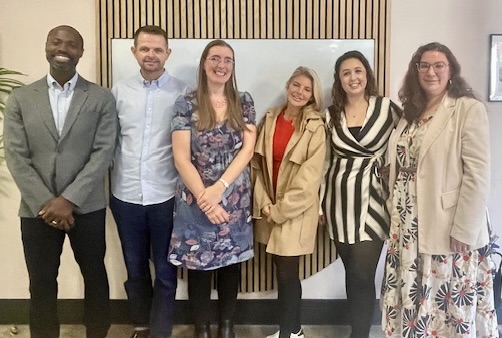
Email marketing may remain a cornerstone of digital strategy but for businesses across all sectors, the challenges are mounting. At a roundtable hosted by TheBusinessDesk.com and sponsored by Campaigner – an advanced cloud-based email and SMS marketing automation platform – industry voices laid bare the obstacles facing digital marketers today. From sheer inbox overload to the rise of AI-driven automation, delegates discussed what it will take to stand out in an increasingly saturated space.
“The biggest challenge is to get clients to open and engage in emails,” said Nicoletta Cantrill, commercial development manager at Wizu Workspace. “Getting that engagement through email is sometimes not always the best course of action, and a lot of the time it might end up in their junk.”
Her words resonated with delegates. Deliverability isn’t just a matter of catchy subject lines, but also of technical barriers and automated systems that filter, screen, and sometimes even trigger false engagement signals.
Joanne Birtwistle, editorial director at Accounting Web, explained how this problem affects B2B campaigns. She said: “A lot of large businesses are increasingly using tech systems to open every email before it lands in that person’s inbox or to click on every single link. Therefore, it doesn’t give you a true reflection of the engagement rate. It massively inflates them.”
This, Jo warned, makes it nearly impossible to measure success using traditional benchmarks like open and click rates.
Customer fatigue is also a persistent issue and, even when messages reach inboxes, consumers are increasingly tuning out. Danielle Best, founder of Mexican fast food restaurant chain, Mexi Bean Express, said: “Customers are inundated with emails. Often people don’t want it and unsubscribe after a one-time purchase from an online shop.”
Her comment highlighted the fickleness of subscriber bases. Discounts and incentives may capture attention, but maintaining long-term engagement requires brands to continually demonstrate value.
Fatigue coupled with the sheer volume of emails people receive daily makes it harder than ever to stand out, therefore marketers must work harder to provide value and relevance if they want to keep their audiences engaged.
For Nathan Atkinson, co-founder Rethink Food CIC, a not-for-profit organisation that works to eliminate hunger and improve health and wellbeing by providing surplus food and educational programs in schools, said the key lies in precise targeting. “If you can get to the right person in the school, it’s not necessarily the decision maker, but then they will take it to the decision maker. Therefore, it’s many kinds of steps and stages.
“Our most successful campaigns have been when we said, right, we’re going to target the leader of the Eco Club, it’s a specific focus that we’ve targeted. We’ve seen much greater success in that sense.”
Mass emailing, he said, is less effective than ever. Identifying gatekeepers and influencers often matters more than simply increasing volumes. His experience reinforced the idea that a tailored approach, rather than a one-size-fits-all strategy, is often the key to higher engagement.
If targeting is critical, the quality of underlying data is just as important. In today’s extremely competitive climate, simply having a large email list is not enough, data needs to be clean, compliant and segmented for maximum impact. Courage Aihevba, SaaS B2B UK sales at Campaigner, said: “It comes down to how the data is sourced. The question is ‘have they opted in to receive information from you’? Because if they have, then that changes things and customisation starts to come into it, where you personalise those messages that are going out to those people.”
Danielle said her approach to boosting engagement is focused on incentives and clear value propositions. “We have pop up banners on our website for customers to subscribe to our mailing list. When they subscribe, they get 25% off their first order.” Her experience highlighted the importance of making the sign-up process attractive and rewarding, especially in consumer-facing businesses.
Sam Goodwin, marketing manager at finance recruitment consultancy, Headstar, shared how her team focuses on value-added content and community engagement to drive results: She said: “We tend to go down the strategy of emailing clients with value-added content rather and we find it is a good way to get people to engage.
“We also run quite a lot of events which are exclusive and aimed at the executive portion of our database. We have excellent engagement within our communities and by having them at our in-person events, we find they are engaged in terms of our marketing content.”
Courage pointed out that clicks are becoming a more reliable indicator than email opens. “Clicks tend to matter more and if you have different sections on your emails, you’re able to then see which of those areas have been engaged with by the recipients.” He explained that, by analysing which parts of an email generate the most interaction, marketers can refine their content and layout to better serve their audience.
But even the best email strategy cannot exist in isolation. Participants agreed that integrating other channels is becoming essential.
Jo highlighted experimenting with WhatsApp communities. She said: “We’ve recently set up a WhatsApp community. We reached out to 100 people yesterday, and we had 15 signs up in the first few hours, which is excellent.”
Danielle shared how Instagram complements her email campaigns, saying: “We’ve found Instagram messaging powerful – people followed us because they’re interested in our brand. Then we follow that up with, ‘here’s a 10% off voucher’.”
Nicoletta discussed incentivising with feedback, saying that vouchers have often been the most effective way to secure responses. “If you fill out the feedback survey, we’ll give you a voucher, and that worked.”
And Courage pointed out where SMS fits into the mix: “If you’ve sent out emails and people still haven’t responded, you can use SMS as a way to remind them that an event is coming up, as long as they’ve opted in to receive information from you.” He suggested that SMS, when used judiciously, can be a powerful complement to email, especially for time-sensitive communications.
No discussion of digital marketing would be complete without mention of AI. Participants revealed how they are already using automation to reduce friction, manage processes, and generate new ideas.
Courage explained how Campaigner integrates AI to enhance campaign creation. He said: “We’ve got that built into our platform where, when you’ve created your template, you put in your subject line, then AI gives you options.”
Sam described how AI is streamlining workflow and reducing manual effort: “We’re just in the infancy but it is already having an impact. For example, if someone makes a phone call to a candidate and they can’t get through, they can then send a note on AI that links to our email system that then raises a task for then.”
Elsewhere, the group also voiced frustration with the limitations of email templates. Danielle captured the sentiment: “They are quite boxy, and I feel like they always look the same. I keep thinking, can’t this be changed little?”
Courage responded by emphasising that more platforms now allow customisation: drag-and-drop design tools, video embedding, and personalisation features that make emails more engaging and flexible.
Ultimately, the round table concluded on a note of both optimism and realism. The fundamentals of email marketing remain unchanged – knowing your audience, providing value, and earning trust – but the tools and tactics are evolving rapidly.
Courage added: “It’s not just about sending emails anymore. There’s SMS and social media as well. It’s about sending messages that includes things like videos and being able to track that messages and manage it all from one place.”
For businesses, that means embracing integration, investing in clean data, and deploying automation intelligently. The inbox may be crowded, but with creativity, precision, and compliance at the core, there is still room to make an impact.

Beyond the inbox: smarter strategies for email marketing in the age of automation – TheBusinessDesk.com