We’re sorry, this feature is currently unavailable. We’re working to restore it. Please try again later.
Add articles to your saved list and come back to them any time.
Prime Minister Anthony Albanese has declared his opposition to the spam texts deluging Australian voters before the federal election this Saturday, but will not commit to changing the law to outlaw the practice.
Mining magnate Clive Palmer’s Trumpet of Patriots party has been sending large volumes of texts, and the mainstream parties also have a history of using unsolicited messages to reach voters.
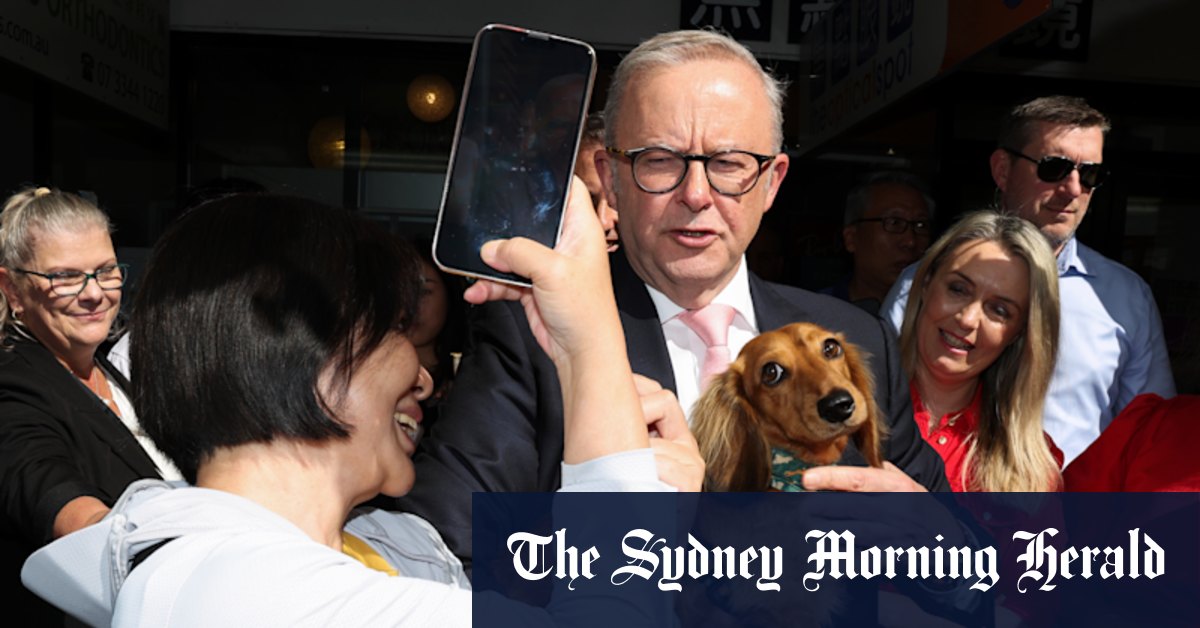
Prime Minister Anthony Albanese won’t commit to do anything to stop the text messages.Credit: Alex Ellinghausen
Albanese said on Melbourne ABC radio on Wednesday that he was against the texts. “I wish that were the case [that the texts were banned],” Albanese said, before adding, “I’m not sure that that fits with our democracy and the capacity people have to campaign.”
“I certainly think that would be a reasonable thing to do, to ban the texts. I’d be happy with that, but I’m not sure that it would fit in with other legal requirements about people having access.”
Australian law exempts political parties from many of the privacy and anti-spam rules that govern companies.
In 2022, voters received a text message on election day from the Liberal Party saying that an asylum seeker boat had been intercepted by Border Force before urging people to vote for the then-Morrison government.
In 2016, a text blast to voters in marginal seats falsely claimed that Malcolm Turnbull was trying to privatise Medicare, infuriating the then-prime minister. He called it an “extraordinary act of dishonesty”.
Tegan Cohen, a research fellow at the Queensland University of Technology, wrote in The Conversation that political parties likely got Australians’ numbers from the electoral roll, information brokers, or by blasting out the messages at random.
In a statement, Palmer hit back at Albanese and said the major parties had colluded to pass the 2003 Spam Act, which exempts politicians from many of its requirements. “It was the Liberals and Labor that both voted in favour of legislation that allows political parties to SMS,” he said.
Tasmanian senator Jacqui Lambie also criticised the major parties, saying they would not change spam laws because they were “just as bad” as Palmer.
Lambie, who quit the Palmer United Party more than a decade ago and now heads her own political party in the Jacqui Lambie Network, was asked on ABC News Breakfast this morning about the unsolicited messages and whether laws needed to change.
“You know what? This is what the majors don’t want to do because they use the same method,” she said. “It’s just that Clive Palmer has got more money than what they have, and he’s spamming a lot more.”
More to come.
Cut through the noise of federal politics with news, views and expert analysis. Subscribers can sign up to our weekly Inside Politics newsletter.
Copyright © 2025

Albanese ‘happy’ to ban annoying texts, won’t commit to make it happen – The Sydney Morning Herald