
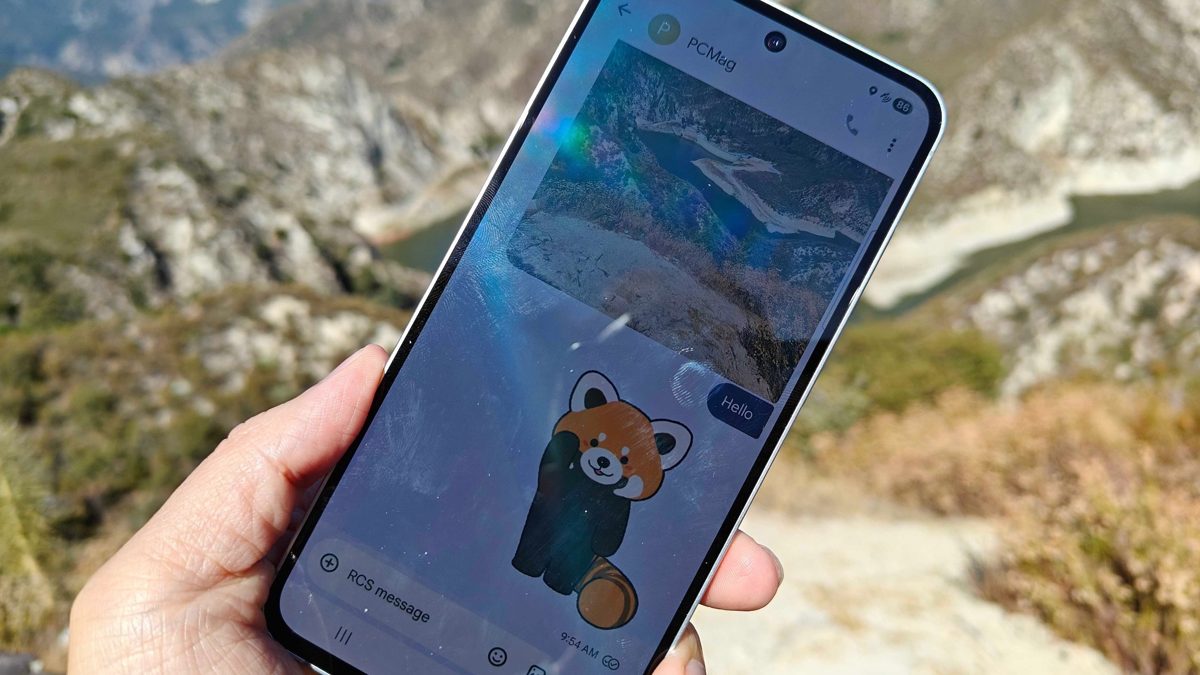

It’s not just SMS texting. T-Mobile’s cellular Starlink service has added a new capability to help it stand out from other satellite-to-phone systems—support for multimedia messaging—and I tested it out recently in Southern California.
T-Mobile added support for Multimedia Messaging Service (MMS) last month following the official launch of T-Satellite. The system, which provides satellite-based connections in cellular dead zones, is largely restricted to SMS messages and location sharing. But MMS works on certain Samsung and Motorola phones; in my tests, I was able to send images, audio clips, and video.
MMS on T-Satellite works just like the satellite-powered SMS messaging, which we also tested. When you enter a cellular dead zone, T-Satellite subscribers should automatically connect to the T-Satellite service, which transmits via a special group of orbiting Starlink satellites. T-Mobile will also send a text to confirm when you’re connected.
While standing near the Big Tujunga Dam in a cellular dead zone, I was able to send a variety of multimedia via the default Messages app on a Samsung Galaxy S24 FE subscribed to T-Satellite. With no cell tower around, the phone used radio signals to communicate with satellites orbiting above. My other phone, an AT&T handset, had no signal.
Like satellite-powered texts, you can expect some lag during the message transmission. In my tests, it sometimes took up to two minutes for an image to go through. Still, every photo was successfully delivered, with confirmation indicators showing they were sent and received.
Although the satellite technology functions best with a clear view of the sky, I didn’t need to go out of my way to hold up the phone. Instead, I used it like normal.
A day later, I was also able to receive images and audio through the satellite service while sitting inside a car on a remote hill. I watched it happen in real time using a second phone on AT&T—which still had service—to send GIFs and audio clips to the Samsung phone. The multimedia took awhile to download, but the GIFs and audio were eventually playable.
I also successfully sent two short video clips, each about 5 seconds long. However, it took over 10 minutes for the first clip to go through and over 20 minutes for the second one. So, sending video isn’t ideal and might drain the battery.
Still, it’s easy to see how MMS capability will make the cellular Starlink service more fun and convenient. I could send GIFs along with images of my surroundings, for example. In contrast, Apple’s iPhone satellite messaging through Globalstar only supports text.
The MMS feature offers a glimpse at how the cellular Starlink service could close coverage gaps in rural and remote areas, where cellular dead zones are common. SpaceX plans on adding voice and video call support over time, although this might require the company to obtain more radio spectrum. In the meantime, T-Mobile says T-Satellite will be able to send data to a select group of third-party apps, including AccuWeather, WhatsApp, and X, in October.
For now, the MMS capability only works on supported Android phones for T-Satellite, not the iPhone 13 to 16 models. But T-Mobile plans on expanding the feature to iPhones later on. Unless you’re on T-Mobile’s most expensive plans (Experience Beyond and Go5G Next), the carrier is charging most customers $10 per month to access T-Satellite. Consumers on rival networks can access it too, but you have to call T-Mobile or visiting one of its stores to sign up.
Meanwhile, AT&T and Verizon are planning their own satellite-to-phone capabilities with the help of Texas-based AST SpaceMobile, which is aiming to kick off its commercial services early next year. In addition, Globalstar is working to upgrade its satellite tech with a new constellation.
Read Our Editorial Mission Statement and Testing Methodologies.
My Experience
I’ve been a journalist for over 15 years. I got my start as a schools and cities reporter in Kansas City and joined PCMag in 2017, where I cover satellite internet services, cybersecurity, PC hardware, and more. I’m currently based in San Francisco, but previously spent over five years in China, covering the country’s technology sector.
Since 2020, I’ve covered the launch and explosive growth of SpaceX’s Starlink satellite internet service, writing 600+ stories on availability and feature launches, but also the regulatory battles over the expansion of satellite constellations, fights with rival providers like AST SpaceMobile and Amazon, and the effort to expand into satellite-based mobile service. I’ve combed through FCC filings for the latest news and driven to remote corners of California to test Starlink’s cellular service.
I also cover cyber threats, from ransomware gangs to the emergence of AI-based malware. Earlier this year, the FTC forced Avast to pay consumers $16.5 million for secretly harvesting and selling their personal information to third-party clients, as revealed in my joint investigation with Motherboard.
I also cover the PC graphics card market. Pandemic-era shortages led me to camp out in front of a Best Buy to get an RTX 3000. I’m now following how President Trump’s tariffs will affect the industry. I’m always eager to learn more, so please jump in the comments with feedback and send me tips.
The Best Tech I’ve Had:
- My first video game console: a Nintendo Famicom
- I loved my Sega Saturn despite PlayStation’s popularity.
- The iPod Video I received as a gift in college
- Xbox 360 FTW
- The Galaxy Nexus was the first smartphone I was proud to own.
- The PC desktop I built in 2013, which still works to this day.
I’ve been a journalist for over 15 years. I got my start as a schools and cities reporter in Kansas City and joined PCMag in 2017, where I cover satellite internet services, cybersecurity, PC hardware, and more. I’m currently based in San Francisco, but previously spent over five years in China, covering the country’s technology sector.
Since 2020, I’ve covered the launch and explosive growth of SpaceX’s Starlink satellite internet service, writing 600+ stories on availability and feature launches, but also the regulatory battles over the expansion of satellite constellations, fights with rival providers like AST SpaceMobile and Amazon, and the effort to expand into satellite-based mobile service. I’ve combed through FCC filings for the latest news and driven to remote corners of California to test Starlink’s cellular service.
I also cover cyber threats, from ransomware gangs to the emergence of AI-based malware. Earlier this year, the FTC forced Avast to pay consumers $16.5 million for secretly harvesting and selling their personal information to third-party clients, as revealed in my joint investigation with Motherboard.
I also cover the PC graphics card market. Pandemic-era shortages led me to camp out in front of a Best Buy to get an RTX 3000. I’m now following how President Trump’s tariffs will affect the industry. I’m always eager to learn more, so please jump in the comments with feedback and send me tips.
Read full bio
PCMag.com is a leading authority on technology, delivering lab-based, independent reviews of the latest products and services. Our expert industry analysis and practical solutions help you make better buying decisions and get more from technology.
For over 40 years, PCMag has been a trusted authority on technology, delivering independent, labs-based reviews of the latest products and services. With expert analysis and practical solutions across consumer electronics, software, security, and more, PCMag helps consumers make informed buying decisions and get the most from their tech. From in-depth reviews to the latest news and how-to guides, PCMag is the go-to source for staying ahead in the digital world.