
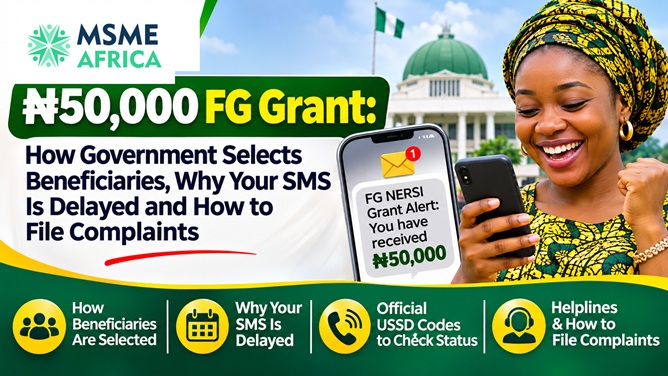

₦50,000 FG NERSI Relief Grant: How Government Selects Beneficiaries, Why Your SMS Is Delayed and How to File Complaints
Civil Defence, Correctional, Fire and Immigration Services Board (CDCFIB) Recruitment 2026: FG Extends Deadline to November 28 for Shortlisted Candidates – NDLEA Drug Test Remains Free
FG Promises Interest-Free Loans to Farmers, Unveils 400 Tractors in Jigawa
UNDP, Olam Agri Partner to Empower 200 Youths in Northeast Nigeria with Entrepreneurship and Baking Skills
Lagos Govt Pushes Food Value Chain Development, Digital Skills to Boost MSMEs and Job Creation
How to Apply for SAIS Livestock Investment Readiness Programme 2027(€15,000 in Business Support)
Call for Application: Sterling Bank and Google Career Certification Program (8 Free Career and AI Certificates for Nigerian Women)
Oneness Revival Team Grants 2026: Nigerian NGOs Can Apply for $25,000–$50,000 Funding – Deadline December 20
Development Bank of Nigeria (DBN)’s $275 Million Climate Fund for Nigerian MSMEs : Apply for Financing for Solar, Agriculture and Green Businesses
Call for Applications: OYSADA/IRP Livestock 2027 Grant Programme for Aquaculture Farmers
UNDP, Olam Agri Partner to Empower 200 Youths in Northeast Nigeria with Entrepreneurship and Baking Skills
Lagos Govt Pushes Food Value Chain Development, Digital Skills to Boost MSMEs and Job Creation
CAC Plans Free .ng Domains, Business Emails and Websites for Registered Nigerian Businesses
Dangote Eyes 500,000-Tonne Cocoa Processing Investment in Ghana
ECOWAS Launches $650 Million Rice Development Project to Boost Food Security in West Africa
How to Apply for SAIS Livestock Investment Readiness Programme 2027(€15,000 in Business Support)
Call for Application: Sterling Bank and Google Career Certification Program (8 Free Career and AI Certificates for Nigerian Women)
FG Opens iDICE Funding for Nigerian Tech and Creative Businesses – Apply for Loans of Up to ₦1 Billion
Anambra 1Youth2Skills Phase 3: Apply for Free Skills Training, Startup Funding and Mentorship Before November 16
Call for Applications: USPF Changemaker Challenge 2026 for Nigerian Innovators ( N10m Cash Prize Pool)
Afreximbank Sets Aside $2bn for African State Projects: How Nigerian MSMEs Could Benefit
Nigeria Could Spend 72% of Government Revenue on Debt by 2030: What It Means for the Economy, Businesses and MSMEs
NLC Denies Negotiating N40,000 Consequential Adjustment for Federal Workers
CBN Gives Banks, Fintechs January 2027 Deadline to Localize Payment Data
FG Approves ₦70,000 Monthly Transport Support for Workers: Who Qualifies and When Will Payments Begin?
Civil Defence, Correctional, Fire and Immigration Services Board (CDCFIB) Recruitment 2026: FG Extends Deadline to November 28 for Shortlisted Candidates – NDLEA Drug Test Remains Free
Julius Berger Internship 2026: How to Apply, Salary, Requirements and Deadline
PremiumTrust Bank Graduate Trainee Programme 2027: Apply for Banking Jobs in Nigeria – No Experience Required
Deloitte Nigeria Academy 2026: Apply for Enterprise Technology & Performance Programme – 24-Month Training for Graduates
Published
on
By
Thousands of Nigerians are still waiting for the Federal Government’s ₦50,000 relief grant under the National Emergency Relief and Stabilisation Intervention (NERSI), with many asking why they have not received payment notifications, how beneficiaries are selected and what to do when the official helpline is not answering.
The Federal Government has now provided further explanations about the selection process, delayed SMS notifications and how beneficiaries can resolve payment-related problems.
The clarification is particularly important for Nigerians who believe they qualify for the ₦50,000 support but have not received a text message from any of the approved payment providers.
According to the Federal Ministry of Humanitarian Affairs and Poverty Reduction, beneficiaries are selected using existing records from the National Social Register and verified national identity records. Payments are also being made in phases, meaning selected recipients may receive notifications at different times.
For those who have already received an SMS but cannot access their money, the government has provided contact channels for the payment providers handling the disbursement.
This report explains who qualifies, how the government selects beneficiaries, why your ₦50,000 SMS may be delayed, how to check your status and where to submit complaints.
What Is the Federal Government’s ₦50,000 NERSI Grant?
Table of Contents
The National Emergency Relief and Stabilisation Intervention (NERSI) is a Federal Government initiative designed to provide financial support to vulnerable households facing rising living costs.
The programme is being implemented by the Federal Ministry of Humanitarian Affairs and Poverty Reduction.
Under the intervention, selected beneficiaries receive ₦50,000 each as a non-repayable grant through mobile wallets operated by approved financial service providers.
The government has clarified that:
- Each selected beneficiary receives ₦50,000.
- The full amount is credited without deductions.
- The support is a grant, not a loan.
- Beneficiaries are not required to repay the money.
- There is no registration fee.
- No agent or government official can demand money to secure inclusion.
The five approved payment providers are ALAT by Wema Bank, MoMo PSB, NairaGram, OPay and Moniepoint.
How Does the Federal Government Select Nigerians for the ₦50,000 Grant?
One of the biggest questions surrounding the intervention is how the government determines who receives the money.
The Ministry has explained that beneficiaries are selected from two existing databases:
- The National Social Register (NSR).
- Verified national identity records linked to the National Identification Number (NIN).
These databases are used to identify and screen poor and vulnerable households.
1. The National Social Register
The National Social Register is a database containing information about poor and vulnerable households across Nigeria.
It is coordinated by the National Social Safety-Nets Coordinating Office (NASSCO).
According to information reported by Punch, the process of identifying vulnerable households involves several stages.
These include:
- Identifying poor local government areas and communities.
- Working with community leaders and trained teams to identify vulnerable households.
- Digitally registering identified households.
- Assessing households using poverty indicators.
- Ranking households according to their level of vulnerability.
The report explains that households ranked within the bottom six deciles may qualify for inclusion in the National Beneficiary Register, which supports programmes such as government cash transfers.
Punch reported that the National Social Register contains data on more than 70 million individuals, although this does not mean that all those individuals will receive the NERSI payment.
2. Verified National Identity Records and NIN
The National Identification Number is another important part of the selection process.
The NIN, issued by the National Identity Management Commission (NIMC), helps the government verify the identity of potential beneficiaries.
According to the government’s explanation, the identity records are linked with the National Social Register to support beneficiary identification and payment.
Having a NIN alone, however, does not automatically qualify someone for the ₦50,000 grant.
3. Selection Is Based on Poverty and Vulnerability
The government says the intervention is intended for poor and vulnerable households.
Selection is based on need and covers all six geopolitical zones, irrespective of religion, ethnicity or political affiliation.
However, the government has not published the complete screening formula or specific individual scoring thresholds used to determine who receives the grant.
This means that Nigerians should not assume that having a NIN, living in a particular state or being registered on a government database automatically guarantees payment.
Important: The government has stated that Nigerians cannot submit a fresh application or pay anyone to be included in the beneficiary list.
Why Have You Not Received the ₦50,000 Grant SMS?
This is currently one of the most frequently asked questions about the programme.
The government has explained that payments are being made in phases, with selected beneficiaries contacted in batches through the approved payment providers.
There are several possible reasons why you may not have received an SMS.
1. Beneficiaries Are Being Contacted in Batches
The government has confirmed that payment providers are not contacting all selected beneficiaries simultaneously.
Some selected recipients may receive their notifications later than others.
Therefore, not receiving an SMS immediately does not necessarily mean you have been excluded from the programme.
2. You May Not Be on the National Social Register
The programme draws beneficiaries from existing records of poor and vulnerable households.
If your household is not included in the relevant database, you may not be part of the pool from which NERSI beneficiaries are selected.
3. You May Not Have Been Selected in the Current Phase
The government has made it clear that not everyone will receive the ₦50,000 support in the current phase.
The intervention is designed to support a limited number of households at a time.
Even if your information appears in government records, this does not guarantee that you will be selected immediately.
4. Your Information May Require Verification
The government uses verified national identity records and information in the National Social Register to identify beneficiaries.
Any discrepancies or limitations in the available records could affect the identification and notification process.
However, the Ministry has not published a detailed list of individual disqualification reasons.
5. You May Be Checking the Wrong Payment Channel
Selected beneficiaries are contacted through one of the five approved payment providers.
These are:
- ALAT by Wema Bank.
- MoMo Payment Service Bank.
- NairaGram.
- OPay.
- Moniepoint.
The notification should come from the authorised provider handling your payment.
The government advises Nigerians to use the approved USSD channels to check their eligibility rather than rely on unofficial registration links.
How to Check If You Have Been Selected for the ₦50,000 Grant
The government has provided USSD channels through which Nigerians can check their eligibility.
The approved payment providers and their corresponding codes are listed below.
| Payment provider | USSD code |
|---|---|
| ALAT by Wema Bank | 94523# |
| MoMo PSB | 6710# |
| NairaGram | 72600# |
| OPay | 95520# |
| Moniepoint | 557327# |
Dial the relevant code and follow the instructions displayed.
Where available, select the option to check your eligibility or payment status.
These codes are for checking through the approved providers. They do not constitute a fresh application or guarantee selection.
If you are not on the current beneficiary list, you may receive a notification indicating that you are not presently selected.
What Should You Do If You Received the ₦50,000 SMS but Cannot Access Your Money?
Some Nigerians have reported problems involving delayed wallet credits, unsuccessful withdrawals, inaccessible accounts and other payment issues.
The government has advised beneficiaries to contact the payment provider responsible for their mobile wallet.
Here are the published customer support contacts.
Official NERSI and Payment Provider Helplines
| Payment provider | Customer support contact |
|---|---|
| ALAT by Wema Bank | 0803 900 3700 |
| MoMo PSB | 671 or 0803 106 7100 |
| NairaGram | 0201 330 0880 or 0201 330 0881 |
| OPay | 0700 888 8328 or 0201 888 8328 |
| Moniepoint | 0700 700 7000 |
Dedicated NERSI helpline: 0700-022-2222
The Ministry advises beneficiaries to contact their payment provider for wallet and transaction problems, while programme selection and administration enquiries should be directed to the NERSI support channel.
Contact details should be verified against the provider’s official website or application before sharing any personal information.
Six Ways to File a Complaint If the NERSI Helpline Is Not Answering
Some beneficiaries have complained that repeated calls to the NERSI helpline have not been answered.
If you are experiencing this problem, there are alternative steps you can take.
1. Contact Your Payment Provider Directly
If you have received an SMS and your problem concerns a missing payment, failed withdrawal or inaccessible mobile wallet, contact the payment provider identified in your notification.
For example, if your notification came from OPay, use OPay’s official customer support channels rather than repeatedly contacting a different payment provider.
2. Use the Provider’s Official Website or Mobile Application
The approved providers have customer support channels through their official websites and mobile applications.
Use these channels to report:
- Failed withdrawals.
- Missing wallet credits.
- Locked or inaccessible wallets.
- Incorrect transaction records.
- Delayed payment processing.
Avoid links sent by unknown individuals or social media accounts.
3. Try Alternative Customer Service Numbers
If the dedicated NERSI helpline is unavailable, use the alternative payment provider numbers listed above.
For general programme enquiries, continue using the official NERSI helpline: 0700-022-2222.
4. Keep Evidence of Your Complaint
If you are experiencing a payment problem, keep relevant records.
These may include:
- The original NERSI notification SMS.
- Transaction reference numbers.
- Screenshots of failed transactions.
- Dates and times of attempted withdrawals.
- Complaint reference numbers.
- Responses received from customer support.
These records can help the payment provider investigate your complaint.
5. Request Escalation of Unresolved Complaints
If your initial complaint is not resolved, request that it be escalated through the payment provider’s established customer service process.
Keep the reference number and record the date of each follow-up.
For a complaint involving an actual financial transaction, follow the provider’s official complaint and escalation procedure.
6. Use Official Government Communication Channels
For questions about beneficiary selection, programme administration or the status of the intervention, consult the Federal Ministry of Humanitarian Affairs and Poverty Reduction.
Official information is available through:
- NERSI information portal: https://www.fmhapr.gov.ng/nersi/
- Ministry website: https://fmhapr.gov.ng/
- NERSI helpline: 0700-022-2222
The Ministry has not confirmed a separate NERSI-specific online complaints portal or a guaranteed complaint-resolution timeframe. Do not mistake unofficial websites or social media forms for government complaint channels.
How to Identify Genuine NERSI ₦50,000 Grant SMS Messages
The government has also warned Nigerians about fraudulent messages and individuals claiming to facilitate payment.
A genuine notification should come from one of the five approved payment providers.
The message will inform selected beneficiaries about the grant and provide instructions for accepting the offer.
Beneficiaries may be required to reply YES or dial the designated USSD code to give consent.
The government has explained that the money is not credited until the beneficiary accepts the offer through the prescribed process.
Watch out for these warning signs:
- Someone asks you to pay a registration fee.
- An agent promises to add your name to the beneficiary list.
- A person demands money to speed up your payment.
- You are asked to provide your PIN or OTP.
- You receive an unofficial link requesting your BVN or banking password.
- Someone promises guaranteed approval in exchange for payment.
The government has made it clear that nobody can influence the selection process or fast-track payment for a fee.
Frequently Asked Questions About the ₦50,000 NERSI Grant
1. Is the Federal Government still paying the ₦50,000 grant?
The government has confirmed that payments are being made in phases under NERSI. Beneficiaries are contacted in batches through the approved payment providers.
2. Why have I not received my ₦50,000 SMS?
You may not have been selected in the current phase, your household may not be included in the relevant social register, or you may be among selected beneficiaries who have not yet been contacted. The government has not published a complete list of individual disqualification reasons.
3. Can I register online for the ₦50,000 NERSI grant?
No. The government has stated that there is no public application or registration process. Beneficiaries are selected using existing government records.
4. Does having a NIN guarantee that I will receive ₦50,000?
No. A NIN is used for identity verification, but selection also relies on the National Social Register and poverty and vulnerability criteria.
5. Is the ₦50,000 grant a loan?
No. It is a grant and does not have to be repaid.
6. Can I pay someone to help me receive the grant?
No. The government has warned against paying agents or intermediaries. Nobody can influence selection or guarantee payment.
7. What should I do if I received the SMS but the money has not entered my wallet?
Follow the instructions in your notification and contact the payment provider responsible for your wallet. Retain the SMS and any transaction reference.
8. What is the official NERSI complaint number?
The dedicated NERSI helpline is 0700-022-2222.
9. Which banks and fintech companies are handling the payments?
The five approved providers are ALAT by Wema Bank, MoMo PSB, NairaGram, OPay and Moniepoint.
10. Can I still receive the grant if I have not received an SMS?
The government says payments are made in batches, and not receiving an SMS does not automatically mean you have been excluded. However, only selected beneficiaries will receive the support in the current phase.
Final Advice: Check Your Status and Avoid NERSI Grant Scams
The Federal Government’s explanations provide some answers to the questions Nigerians have been asking about the ₦50,000 NERSI relief grant.
The most important points are that beneficiaries are selected through existing government records, payments are made in phases, and there is no public application process.
If you have received an SMS but are experiencing difficulties accessing your money, contact the payment provider responsible for your wallet and retain evidence of your complaint.
If you have not received a notification, use the approved channels to check your status. Do not pay anyone who claims to have the ability to secure your selection.
For official information, visit:
https://www.fmhapr.gov.ng/nersi/
NERSI helpline: 0700-022-2222
Share this report with friends and family who are waiting for the ₦50,000 Federal Government relief grant. It could help them understand the selection process, check their status and avoid falling victim to fraudsters.
Related Posts:

OPay Federal Government ₦50,000 NERSI Relief:…

Federal Government ₦50,000 NERSI Relief Grant: How…

FG ₦50,000 Relief Grant: Why You Have Not Received…

FG Renewed Hope ₦75,000 Cash Transfer 2026: Is…
Ruth Titilayo Educational Foundation Scholarship 2026
MSME Africa Unveils Top 50 Remarkable MSME Founders…
Civil Defence, Correctional, Fire and Immigration Services Board (CDCFIB) Recruitment 2026: FG Extends Deadline to November 28 for Shortlisted Candidates – NDLEA Drug Test Remains Free
FG Explains How Vulnerable Households Can Be Added to National Social Register
Federal Government ₦50,000 NERSI Relief Grant: How to Identify Genuine Payment SMS and What to Do If You Cannot Withdraw Your Money
FG Announces How Wema Bank Customers Can Check Eligibility for ₦50,000 Grant
Nigerian Banks Begin Contacting ₦50,000 FG Grant Beneficiaries in Payment Batches
MoMo Outlines Steps for Beneficiaries to Access FG’s ₦50,000 Relief Support
How Moniepoint Customers Can Check Eligibility for FG’s ₦50,000 Relief Support
Your email address will not be published.
Published
on
By
Young people in Anambra State can now apply for the third phase of the government’s 1Youth2Skills Plus Programme, an empowerment initiative offering free vocational training, entrepreneurship education, business start-up funding and one year of mentorship.
The Anambra State Government is targeting 15,000 young people in the latest phase, giving eligible residents an opportunity to acquire practical skills and build businesses.
Registration opened on 10 November 2026 and the official application portal currently lists 16 November 2026 as the closing date.
The programme is open to graduates, non-graduates and school leavers who meet the eligibility requirements.
Here is how to apply, the benefits, requirements and official registration link.
What Is Anambra 1Youth2Skills Plus?
1Youth2Skills Plus is an Anambra State Government youth empowerment programme designed to equip young people with practical vocational skills and help them establish sustainable businesses.
The third phase builds on the first two batches, which reportedly trained and supported more than 13,000 young people across over 60 skill areas.
The programme goes beyond skills acquisition. Participants also receive entrepreneurship training, business support, start-up funding opportunities and mentorship.
What Are the Benefits?
Successful participants can access:
- Free vocational training: Four to six months of practical training with experienced master trainers.
- Entrepreneurship training: Business education delivered in partnership with UNIZIK Business School.
- Business certification: Participants who meet the programme’s requirements can receive relevant certifications.
- Start-up funding: Graduates can receive financial support to establish businesses and purchase necessary tools.
- Cooperative membership: Participants are organised into cooperatives to support business development.
- One-year mentorship: Graduates receive mentorship to help them establish and grow their businesses.
The start-up funding is part of the programme’s post-training support; registration does not guarantee an immediate cash payment to every applicant.
Who Can Apply for 1Youth2Skills Phase 3?
The programme is designed for residents of Anambra State.
According to the official registration portal, applicants must:
- Be between 18 and 40 years old.
- Live in Anambra State.
- Be able to read and write.
- Be available for at least four days of physical training every week.
Graduates, non-graduates and school leavers can apply. Persons with special needs are also given special consideration.
Age clarification: An Anambra State Government announcement describes the general age range as 18–35, with exceptions up to 40 in special circumstances, while the live registration portal lists 18–40. Applicants aged 36–40 should confirm their eligibility with the Ministry before completing registration.
What Skills Can Applicants Learn?
The programme offers more than 60 vocational and practical skill areas.
These include:
- Fashion design and tailoring.
- Solar installation.
- Agriculture.
- Artificial intelligence and digital skills.
- ICT and technology.
- Automobile repairs.
- Furniture making.
- Plumbing.
- Catering.
- Cosmetology.
- Phone repairs.
- Cinematography.
- CCTV installation.
Applicants can select two preferred skills during registration and will be matched with an available master trainer in their local government area.
What Are the Requirements?
Before starting your application, prepare:
- A valid email address.
- An active phone number.
- Your National Identification Number (NIN).
- Your Bank Verification Number (BVN).
- Your Anambra State Identification Number (ASIN).
- Your residential address and local government area.
- Your preferred skills.
Applicants without an ASIN can obtain one through the official registration platform or an Anambra State Internal Revenue Service office.
How to Apply for Anambra 1Youth2Skills Phase 3
Follow these steps:
- Visit the official application portal: https://1youth2skills.anambrastate.gov.ng/
- Select Register as a Trainee.
- Create an account using your email address and phone number.
- Enter your NIN, BVN and ASIN for identity verification.
- Select your first and second preferred skills.
- Provide your residential address and local government area.
- Submit your registration and follow the instructions for verification and placement.
The registration process takes approximately 15 minutes.
Is the 1Youth2Skills Registration Free?
Yes. Registration is free through the official Anambra State Government portal.
Applicants should not pay anyone to register, secure a training position or obtain preferential placement.
Final Reminder
Anambra’s 1Youth2Skills Plus Phase 3 offers more than vocational training. Eligible young people can acquire practical skills, receive entrepreneurship education, access business start-up support and benefit from a year of mentorship.
With 15,000 places targeted and registration closing on 16 November 2026, interested Anambra residents should complete their applications promptly.
Apply here: https://1youth2skills.anambrastate.gov.ng/
Published
on
By
Nigerian students in public tertiary institutions can now apply for the Federal Government’s 2026/2027 student loan through the Nigerian Education Loan Fund (NELFUND).
The programme provides interest-free student loans to help eligible Nigerians pay their institutional fees and access an optional upkeep allowance while pursuing higher education.
The application window opened on 23 September 2026, with 31 December 2026 announced as the closing date for the current cycle.
The development provides an opportunity for students who need financial support to continue their education without depending entirely on parents, guardians or personal savings.
Here is how to apply, who qualifies, the documents required and the official NELFUND student loan portal.
What Is the NELFUND Student Loan?
The Nigerian Education Loan Fund is a Federal Government initiative established under the Students Loans (Access to Higher Education) Act 2024.
It provides interest-free loans to eligible Nigerian students to support access to higher education.
The loan covers two major areas:
- Institutional fees: Approved funds are paid directly to the student’s tertiary institution to cover eligible charges.
- Upkeep allowance: Eligible students may receive an optional allowance directly into their bank accounts to help with living expenses.
NELFUND is a loan scheme, not a grant. Beneficiaries are expected to repay the funds under the programme’s repayment conditions.
Who Can Apply for the NELFUND Student Loan 2026/2027?
The scheme is open to eligible Nigerian students admitted into participating public tertiary institutions.
Applicants may include:
- Newly admitted students with valid JAMB admission.
- Direct Entry students with valid admission.
- Existing full-time undergraduate students with matriculation numbers.
- Students in eligible public universities, polytechnics, colleges of education and other approved institutions.
Applicants must also satisfy the identification and verification requirements.
Who May Not Qualify?
Under the published NELFUND guidelines, applicants may be disqualified if they:
- Have defaulted on a previous government education loan.
- Are already beneficiaries of another government education loan or scholarship.
- Hold a first degree or its equivalent.
- Have been convicted of specified offences involving fraud, forgery or dishonesty.
- Have been dismissed for specified serious academic misconduct.
Applicants should review the official guidelines before submitting their applications.
What Are the Requirements for NELFUND Application?
Students should prepare the following information and documents:
- Valid JAMB registration number.
- National Identification Number (NIN).
- Bank Verification Number (BVN), for applicants aged 18 and above.
- Valid admission letter or student identification card.
- Matriculation number, where applicable.
- Personal details, including phone number and email address.
- Passport photograph.
- Relevant academic and institutional information.
Important: Ensure that your name, JAMB details, matriculation number, department and other academic records match the information held by your institution.
Incorrect or incomplete records can delay verification and loan processing.
How to Apply for the NELFUND Student Loan 2026/2027
Applications are submitted online through the official NELFUND platform.
Follow these steps:
Step 1: Visit the official portal
Go to https://nelf.gov.ng/ and click on the application button.
Step 2: Create an account
Register using your personal information and follow the verification instructions.
Step 3: Select Request for Student Loan
Log in to your account and select the student loan application option.
Step 4: Complete the application form
Provide your JAMB details, NIN, BVN, institution information and other requested details.
Step 5: Upload the required documents
Attach your admission letter or student ID and any other documents requested by the portal.
Step 6: Review and submit
Check your information carefully before submitting the application.
Step 7: Monitor your application
Your institution and NELFUND will verify your information. Successful applicants will receive notifications through the appropriate channels.
<box border radius=”lg” padding={3} gap={2}> <badge color=”success”>Official application portal</badge> **Apply for the NELFUND Student Loan 2026/2027**
<title size=”xl” color=”success”>31 December 2026</title> <text color=”secondary” size=”xs”>Announced application deadline. Confirm any institution-specific updates.</text> <button block onClick={() => GenUI.openUrl(“https://nelf.gov.ng/“)}>Visit NELFUND Official Website <icon name=”external-link” size=”xs”/></button> <text color=”secondary” size=”xs”>The application link on the official website takes applicants to the student loan portal.</text> </box>
How Is the NELFUND Loan Repaid?
Although the loan is interest-free, beneficiaries are required to repay it.
Under the published repayment guidelines:
- Repayment begins two years after completing the NYSC programme or obtaining an exemption.
- Employed beneficiaries repay 10% of their salary through deductions at source.
- Self-employed beneficiaries repay 10% of their monthly profits.
- Beneficiaries who are unemployed and have no income may apply for an extension in accordance with the programme’s requirements.
Students should carefully review the loan agreement and repayment obligations before accepting an approved loan.
Important Things Students Should Know
Before applying, keep these points in mind:
- NELFUND is an interest-free loan, not free money or a grant.
- Institutional fees are paid directly to the institution.
- Upkeep allowance is optional and subject to the applicable approval and disbursement arrangements.
- Applying does not automatically guarantee approval or immediate payment.
- Your institution must verify your academic records.
- Use only the official NELFUND website. Do not pay agents to process your application.
Frequently Asked Questions
Is the NELFUND student loan application open for 2026/2027?
The 2026/2027 application cycle opened on 23 September 2026. The announced deadline is 31 December 2026.
Is NELFUND free money?
No. It is an interest-free loan that beneficiaries are expected to repay under the programme’s terms.
Can fresh students apply?
Yes. Newly admitted students with valid JAMB admission into eligible institutions can apply.
Can students in state universities apply?
Eligible students in participating public institutions, including state universities, can apply. Students should confirm that their institution is participating and has uploaded the required records.
Does NELFUND pay school fees directly?
Yes. Approved institutional charges are paid directly to the eligible tertiary institution.
Do students receive monthly upkeep allowance?
The scheme provides for an optional upkeep allowance. Its availability and disbursement are subject to the applicable approval arrangements.
When does repayment begin?
Under the published guidelines, repayment begins two years after completion of NYSC or exemption.
Where can I apply for the NELFUND student loan?
Visit the official portal: https://nelf.gov.ng/
Final Reminder: Apply Before the Deadline
The NELFUND Student Loan Scheme provides an important financing option for Nigerian students who need support to pay for higher education.
Eligible students planning to apply for the 2026/2027 academic session should prepare their documents, verify their institutional records and complete their applications before the announced 31 December deadline.
Apply through the official NELFUND portal: https://nelf.gov.ng/
Do not pay anyone who promises to secure approval or speed up your application.
Published
on
By
Nigerian entrepreneurs, innovators, developers, engineers and researchers have just a few days left to apply for the NIMASA Blue Economy Accelerator Programme (NIMASA-BEAP) 2026, a Federal Government initiative designed to identify and develop innovative solutions for Nigeria’s maritime and blue economy.
Applications close on Friday, 13 November 2026.
The programme features 13 innovation tracks covering opportunities in maritime technology, shipping and logistics, port operations, marine biotechnology, fisheries, marine tourism, ocean data and other areas of the blue economy.
Unlike conventional business grant programmes, NIMASA-BEAP is designed to help promising ideas and startups progress through a national innovation pipeline involving a hackathon, mentorship, venture development and access to investors and industry partners.
Selected participants will have the opportunity to compete in the National Innovation Hackathon scheduled for 8–10 December 2026, with successful ventures progressing to a 12-week accelerator programme in 2027.
If you have an innovative idea or startup that can solve a problem in Nigeria’s maritime industry, this is an opportunity to consider.
Here is a practical guide to eligibility, the application requirements, documents to prepare and how to submit your application before the deadline.
What Is the NIMASA Blue Economy Accelerator Programme?
The NIMASA Blue Economy Accelerator Programme is an initiative of the Nigerian Maritime Administration and Safety Agency (NIMASA), under the Federal Ministry of Marine and Blue Economy.
The programme aims to encourage innovation, entrepreneurship and investment across Nigeria’s maritime and ocean-based economy.
It seeks to identify promising Nigerian innovators and startups, help them develop practical solutions to industry challenges and connect them with potential investors, corporate partners and customers.
The programme is being implemented through several stages:
- National call for innovators.
- Application evaluation and due diligence.
- National Innovation Hackathon.
- A 12-week accelerator programme.
- National Demo Day and engagement with investors and industry stakeholders.
The initiative is intended to go beyond a conventional competition by helping innovative ideas develop into commercially viable ventures.
Who Can Apply for NIMASA-BEAP 2026?
NIMASA has removed the earlier age restriction following public demand. Nigerians aged 18 and above can now apply, regardless of gender, ethnicity, religion or educational background.
The opportunity is open to:
- Entrepreneurs and startup founders.
- Software developers and technology innovators.
- Engineers and technical professionals.
- Researchers and academics.
- Graduates and university students.
- Artisans and other innovators with relevant solutions.
- Individuals and teams developing solutions for maritime and blue economy challenges.
The official portal’s eligibility information identifies the following requirements:
- The applicant should be a Nigerian-registered startup or a startup in the process of registration.
- The startup should operate within the maritime or blue economy sector.
- At least one founder or co-founder must be Nigerian.
- The team should have at least two members.
- The solution may be at the idea, Minimum Viable Product (MVP), early-revenue or growth stage.
- Applicants must be willing to participate in the programme.
Important: CAC registration is not compulsory at the application stage. The portal accepts applications from individuals as well as registered companies, and a CAC certificate is listed as optional. However, the programme’s eligibility information requires a team of at least two members.
What Are the 13 NIMASA Innovation Tracks?
Applicants are expected to identify the innovation track that best matches their proposed solution.
The 13 tracks cover different segments of the maritime and blue economy.
1. Maritime Technology and Logistics
Innovations that improve maritime transportation, shipping operations, cargo movement, logistics management and efficiency across the maritime value chain.
2. Maritime Safety, Surveillance and Security
Solutions that improve vessel monitoring, maritime surveillance, security operations, incident detection and safety at sea.
3. Green Shipping and Vessel Decarbonisation
Technologies and innovations that reduce emissions, improve fuel efficiency and promote environmentally sustainable shipping.
4. Seafarer Welfare
Solutions addressing seafarer health, safety, welfare, training, working conditions and professional development.
5. Port Digitisation
Digital technologies that improve port operations, documentation, cargo handling, administration and operational efficiency.
6. Marine Waste Management
Innovations that address marine pollution, waste collection, recycling and sustainable waste management in coastal and maritime environments.
7. Aquaculture and Sustainable Fisheries
Solutions that improve fish farming, sustainable fish production, aquaculture management and fisheries productivity.
8. Coastal and Artisanal Fishing Value Chain
Innovations supporting small-scale fishing communities, fishing equipment, processing, preservation, distribution and market access.
9. Ocean Data and Analytics
Technologies that collect, process and analyse ocean and maritime data to support better decisions and operations.
10. Nature-Based Coastal Defence Solutions
Innovations that use natural ecosystems and environmentally sustainable approaches to protect coastal communities against erosion, flooding and other environmental threats.
11. Marine Tourism and Coastal Recreation
Solutions that promote marine tourism, coastal recreation, water-based leisure activities and related business opportunities.
12. Marine Biotechnology
Innovations that use marine organisms and biological resources for applications in healthcare, agriculture, food production, industry and environmental management.
13. Deep Seabed Mining Technologies and Research
Technologies and research solutions relating to deep-sea exploration, seabed resources and responsible marine resource management.
Applicants should select the track that most closely reflects the problem their solution addresses rather than simply choosing the most popular category.
What Documents Do You Need to Apply?
The NIMASA-BEAP portal provides an eight-stage application process. Applicants should prepare the following information and documents before starting.
1. Startup or project information
You will be asked to provide:
- Startup or project name.
- Founding date.
- State of operation.
- Applicant type.
- CAC registration number, if registered.
- Website or social media links, where available.
2. Founder and team information
Prepare details about the lead founder and other team members.
The portal requests information such as:
- Founder names and roles.
- Gender and age.
- LinkedIn profiles.
- Number of people in the team.
- Details of up to four co-founders.
3. Blue economy subsector
Identify the primary and secondary subsectors relevant to your solution.
You will also need to indicate the current stage of your startup or project, such as:
- New idea.
- Minimum Viable Product (MVP).
- Early revenue.
- Growth stage.
4. Business and solution description
You should be able to explain:
- The problem your innovation addresses.
- Your proposed solution.
- The target market or beneficiaries.
- How the product or service works.
- Your existing customers and revenue, where applicable.
The portal allows applicants to provide a problem-and-solution statement of up to 300 words.
5. Innovation and impact statement
Explain what makes your solution different and how it can contribute to the maritime and blue economy.
You should also describe its potential environmental or social impact and its alignment with relevant Sustainable Development Goals (SDGs).
6. Funding and financial information
Applicants will be asked about previous funding received, where applicable, and how they intend to use NIMASA-BEAP support.
The portal provides a maximum of 200 words for explaining the proposed use of programme support.
7. Supporting documents
The official application portal identifies the following document requirements:
| Document | Format and size |
|---|---|
| Pitch deck | PDF, maximum 10MB |
| Founder identification | PDF, JPG or PNG, maximum 3MB |
| CAC certificate | PDF, maximum 5MB; optional |
The pitch deck and founder identification are particularly important. Prepare them before beginning the application.
How to Apply for NIMASA Blue Economy Accelerator Programme 2026
Applications are submitted online through the official NIMASA-BEAP portal.
Official application portal: https://nbeap.nimasa.gov.ng/
Follow these steps:
Step 1: Visit the official NIMASA-BEAP website
Go to https://nbeap.nimasa.gov.ng/ and select the option to apply as a startup.
Step 2: Create an account
Register with your email address and provide the information required to establish your applicant account.
Step 3: Complete your startup profile
Enter your startup or project name, founding date, location, registration status and other relevant details.
You can apply as an individual or registered company, subject to the programme’s team and eligibility requirements.
Step 4: Add your founders and team members
Provide the details of your lead founder and other team members. The portal allows you to include up to four co-founders.
Step 5: Select your innovation track
Choose the blue economy subsector that best describes your solution.
Select the current development stage of your project, whether it is an idea, MVP, early-revenue venture or an established growing business.
Step 6: Explain your innovation
Describe the problem you are solving, your proposed solution, its uniqueness, target market and expected impact.
Be specific. Explain how your innovation can improve operations, address an industry challenge or create value within the maritime and blue economy.
Step 7: Upload your supporting documents
Upload your pitch deck and founder identification in the accepted formats.
You may also upload your CAC certificate if your business is registered.
Step 8: Review and submit
Check all the information you have provided, accept the required declarations and data-protection consent, and submit your application.
The portal indicates that applicants receive a confirmation after successful submission.
You can save your progress and return to complete the application before the deadline.
What Happens After You Apply?
The programme has a defined selection and implementation timeline.
| Programme stage | Expected dates |
|---|---|
| Application deadline | 13 November 2026 |
| Evaluation and due diligence | 16 November – 2 December 2026 |
| National Innovation Hackathon | 8–10 December 2026 |
| 12-week accelerator | January–April 2027 |
| National Demo Day | Second quarter of 2027 |
Applicants should understand that submitting an application does not automatically guarantee selection for the hackathon or accelerator.
Successful participants will progress through the programme’s selection process and may receive opportunities for mentorship, venture development, industry exposure and engagement with investors and potential customers.
What Will Selected Innovators Gain?
The NIMASA-BEAP programme is designed to connect promising ventures with the resources and relationships needed to develop their solutions.
The expected benefits include:
- Participation in the National Innovation Hackathon.
- Access to structured mentorship.
- Technical and business-development support.
- Exposure to maritime industry stakeholders.
- Opportunities to connect with investors and corporate partners.
- Participation in the 12-week accelerator programme for selected ventures.
- Opportunities to showcase solutions at the National Demo Day.
Does the programme guarantee a cash grant?
The programme portal refers to funding opportunities, investor access and venture-development support. However, applicants should not assume that every participant will receive a fixed cash grant or that selection guarantees investment. No universal cash award amount is stated in the application information.
Tips for Submitting a Strong NIMASA-BEAP Application
With applications closing soon, innovators should focus on presenting clear, practical and credible solutions.
Here are some recommendations:
1. Identify a real maritime problem.
Your application should demonstrate that you understand a genuine challenge within the maritime or blue economy.
2. Explain your solution clearly.
Avoid unnecessary technical language. Describe what your solution does, how it works and who will benefit.
3. Demonstrate what makes your idea innovative.
Explain how your proposed solution improves on existing approaches or addresses a problem that is not being adequately solved.
4. Show evidence of feasibility.
If you already have a prototype, product, demonstration or early customers, include relevant evidence.
However, the programme also accepts early-stage ideas, so do not assume you need a fully developed product to apply.
5. Prepare a convincing pitch deck.
Your presentation should clearly communicate the problem, solution, market, business model, innovation, impact and development plan.
6. Explain how your venture can grow.
Show how your solution could be adopted by maritime operators, shipping companies, ports, fishing communities, coastal businesses or other relevant customers.
Frequently Asked Questions
Is NIMASA-BEAP open to all Nigerians?
Yes. NIMASA removed the earlier age restriction. Nigerians aged 18 and above can apply, regardless of gender, ethnicity, religion or educational background, provided they meet the programme’s other requirements.
Do I need to be a maritime expert to apply?
No. The programme welcomes innovators from different professional and educational backgrounds, provided their solutions address relevant maritime or blue economy challenges.
Can I apply with just an idea?
Yes. The official portal accepts startups at the new-idea stage, as well as those with an MVP, early revenue or an established growth-stage business.
Is CAC registration compulsory?
No. The CAC certificate is listed as optional, and the portal accepts applicants with startups that are registered or in the process of registration.
Can I apply as an individual?
The portal provides an individual applicant option. However, its eligibility information also specifies a minimum team size of two members. Applicants should ensure their team details satisfy this requirement.
Is there an application fee?
No. Applications are free. NIMASA has warned that applicants should not pay anyone to access the programme.
When is the application deadline?
Applications close on Friday, 13 November 2026.
When will the National Innovation Hackathon take place?
The hackathon is scheduled for 8–10 December 2026.
Does winning the hackathon guarantee funding?
No fixed cash prize is guaranteed to every applicant or participant. The programme offers a pathway to mentorship, accelerator support, funding opportunities and investor engagement, subject to selection and the programme’s terms.
Final Thoughts
Nigeria’s maritime and blue economy offers opportunities in shipping, logistics, fisheries, marine technology, tourism, environmental protection and several other sectors.
The NIMASA Blue Economy Accelerator Programme provides a platform for Nigerian innovators to develop solutions that can address challenges in these industries and potentially build commercially viable businesses.
With applications closing on 13 November 2026, interested entrepreneurs, developers, engineers, researchers and innovators should begin preparing their pitch decks and supporting documents immediately.
You do not need to be an established maritime company or have a fully developed product to apply. The programme accepts early-stage ideas, provided they meet the eligibility requirements and address a relevant blue economy challenge.
Application deadline: Friday, 13 November 2026.
Apply free through the official NIMASA-BEAP portal:
https://nbeap.nimasa.gov.ng/
Application guide: https://nbeap.nimasa.gov.ng/guide
This article is based on information published by NIMASA and its official programme portal. Applicants should review the current portal requirements before submitting their applications.
Related post : Call For Applications: NIMASA Blue Economy Accelerator Programme 2026
BREAKING: CBN announces New Withdrawal Policies, Pegs ATM Withdrawals Limit at N20,000 daily, N100,000 weekly
First Bank Nigeria Joins SME Finance Forum
FG Opens Application Portal for N75 Billion MSME Survival Fund 10pm Today, Releases Time-table for Payroll Support Scheme for different sectors
Sendbox raises $1.8 million in seed funding to digitize deliveries for African SMEs
Call for Applications: MTN ICT and Business Skills Training (N90 Million Grant for 300 Participants)
How to apply and benefit from free CAC Business Name Registration for 250,000 MSMEs
Call for Applications: Rural Youth Skill Acquisition Programme for Nigerian Youths (receive N50,000 monthly stipend)
How to put your house in order for tax purposes
Copyright © 2026 Msme Africa | All rights reserved