

He informed his sister not to visit the webpage in any messages she received from his SMS blaster.
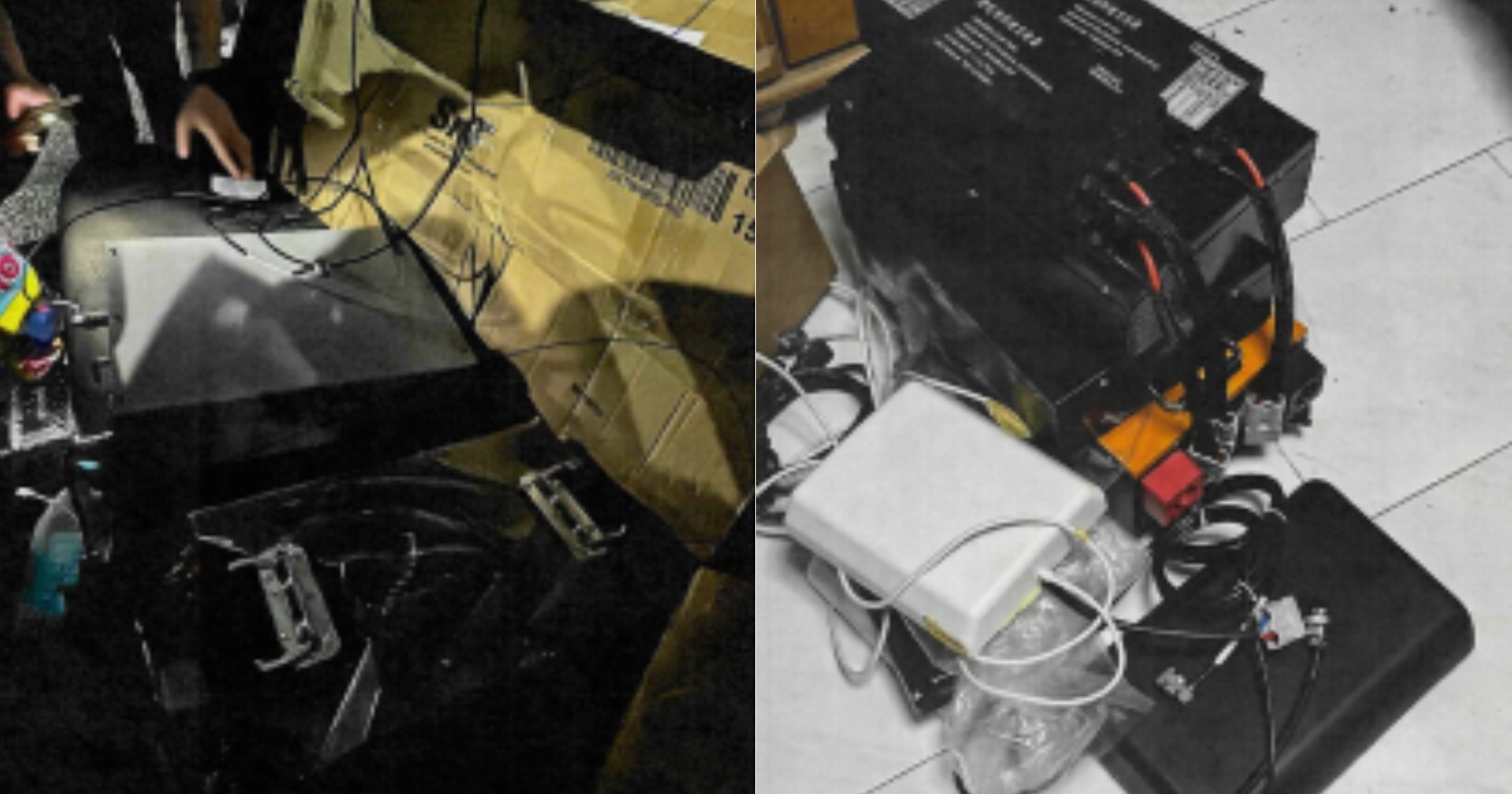
Photos from court documents 

A 28-year-old Malaysian man drove around Singapore in a car with a device known as an SMS blaster that sent phishing messages to fraudulently obtain WhatsApp account login credentials.
He was sentenced to one year and nine months’ jail and fined S$1,500.
Ong Kak Seng faced three charges consisting of cheating and charges under the Computer Misuse Act.
He pleaded guilty to one charge and was sentenced on Sep. 14.
The rest of the charges were taken into consideration during sentencing.
Job
In court documents seen by Mothership, Ong became acquainted with a man identified as “Bai Ge” in Malaysia in 2023.
Ong knew him as he was tasked by another person to collect debt repayments from Bai Ge.
Over time, Ong struck up a friendship with Bai Ge.
In October 2025, Bai Ge learned that Ong owed approximately RM80,000 (S$24,943) to various unlicensed moneylenders.
He then offered him a job opportunity to earn RM1,000 (S$311.78) in cash per day by driving around densely populated areas in Singapore or Hong Kong for 10 to 12 hours daily with an SMS blaster in the car.
Bai Ge also informed Ong that he had a “boss” based in China who specialised in operating SMS blaster devices and disseminating messages through them.
Ong believed that the SMS blaster device would be used to disseminate messages promoting illegal online gambling platforms to persons in the vicinity of the device.
He was also aware that the job involved illegal activities, as a driver in Malaysia would ordinarily be paid approximately RM3,000 (S$935.35) a month for legitimate driving services.
Bai Ge offered a salary of almost 10 times that amount.
However, Ong was enticed by the job’s earning prospects and agreed to take it up.
Ong also told Bai Ge he wanted to work in Singapore instead of Hong Kong, as he could drive his own car there.
Hence, Bai Ge enlisted the accused to work for him in Singapore.
Training
In October 2025, Ong visited Bai Ge’s residence in Malaysia.
He received training on how to assemble and set up an SMS blaster device from various components, including batteries, antennae, wires, remote controls, and other items.
On Oct. 11, 2025, Ong travelled from Malaysia to Singapore and met another person whom Bai Ge instructed him to meet.
This individual then handed Ong a black motorcycle box and a brown box containing parts he could use to assemble an SMS blaster device.
He then brought the parts back to a residential unit, whose owner he did not know.
However, he knew that Bai Ge had arranged with other parties to make the residential unit available for him to reside in.
Ong was also allowed to reside at the residential unit as long as he helped Bai Ge drive around Singapore in high-traffic areas, with the SMS blaster device placed in his car.
Function
On Oct. 12, 2025, Ong assembled the SMS blaster and placed it at the rear of his car.
He was then added to a Telegram group named “Xin Jia Po Qun”, which meant Singapore group, with other persons, including Bai Ge and others whom he believed were from China, including the “boss” whom Bai Ge reported to.
Ong then took a photograph of the assembled SMS blaster in the rear of his car and sent it to the Telegram group chat to inform them that he had successfully assembled the device.
He then visited a handphone store in Geylang to purchase two mobile phones and downloaded an application on both.
He used one of the mobile phones alongside his own.
Ong operated one mobile phone as a primary device.
Through the application, he could pair the primary device with the SMS blaster device, enabling him to turn the SMS blaster device on and off remotely.
Ong used his personal mobile phone as a secondary device and turned on its mobile hotspot function.
With the mobile hotspot function turned on, he paired the secondary device with the primary device and enabled the primary device to access the internet.
Drive
Between Oct. 13 and Nov. 18, 2025, Ong drove his car to numerous locations in Singapore for 10 to 12 hours each day, carrying the SMS blaster device, antennae, and various battery packs.
He also covered the SMS blaster device with a cardboard box to conceal it.
After one or two days of driving, Ong discovered, by reading the messages the SMS blaster device would transmit, that it was sending WhatsApp account phishing messages to people in the vicinity of the device.
Between October 2025 and November 2025, Ong also met with an individual identified as “Lie Dao Jing”, whom he knew as “Ah Jing”, at least three times under the instruction of Bai Ge.
During these meetings, Ong handed Lie Dao Jing various parts for assembling an SMS blaster device, as well as sums of cash, as Bai Ge informed him.
Ong knew that Lie was performing the same services as him and that he was also working for Bai Ge.
Sister
On Oct. 15, 2025, Ong drove to visit his sister in Singapore, with the SMS blaster device in the rear of his car.
As Ong knew his sister might receive WhatsApp account phishing messages transmitted by the SMS blaster, he told her not to visit any webpage in any messages she received.
He knew his sister was vulnerable to such scams, as she had previously been a victim of a scam.
Arrest
In October and November 2025, the Singapore Police Force (SPF) received multiple reports from members of the public about suspicious WhatsApp and text messages on their mobile devices.
The messages claimed that recipients had issues verifying their WhatsApp accounts.
They would then ask recipients to provide their WhatsApp account login credentials via a link to a fraudulent landing page designed by third parties to obtain those credentials and facilitate account takeovers.
Between Nov. 18, 2025, and Nov. 19, 2025, officers from the SPF’s Police Intelligence Department and Commercial Affairs Department (CAD) conducted an islandwide operation to apprehend the individuals involved in the transmission of these WhatsApp account phishing messages.
On Nov. 18, 2025, Ong was arrested on suspicion of being part of a transnational syndicate perpetrating WhatsApp account phishing scams in Singapore.
CAD officers searched his car and the residential unit.
Ong also claimed that before his arrest, he had received RM5,000 (S$1,558) in exchange for services he performed for Bai Ge.
Impact
Investigations revealed that at least 31,820 mobile phones fell within the SMS blaster’s coverage area, and 10,533 WhatsApp account phishing messages were successfully transmitted to mobile devices while Ong operated the SMS blaster.
At least one police report was also lodged, in which a complainant reported a loss of S$1,823.26 after receiving the WhatsApp account phishing messages.
The complainant was induced into transferring money to a bank account controlled by a third party.
Deliberate
The prosecution sought 21 to 25 months’ jail and a fine of RM5,000 (S$1,558), which was equivalent to the sum he received.
They argued that Ong “deliberately” performed such services in Singapore for the prospect of a higher income.
“Understanding the harmful effects of such messages, the accused even warned his own sister not to act on the contents of the messages sent by the SMS blaster device,” they said.
The prosecution also said there was a “transnational element” in this case.
“Transnational criminals are likely to be emboldened by the prospect of getting away scot-free. In a rare instance where they are arrested and prosecuted, general deterrence is of paramount concern, to create awareness in the public and among potential offenders that punishments will be ‘certain and unrelenting’,” they said.
They cited premeditation and an “element of sophistication” in the offences and argued that Ong needed training to operate the SMS blaster.
“He single-handedly assembled the SMS blaster device in Singapore, and drove around Singapore with a functional SMS blaster device in his motorcar with limited assistance,” they said.
Debt
According to CNA, Ong’s lawyers sought no more than 18 months’ jail for Ong.
They claimed Ong used to work on a farm before entering a pawn-related business in Malaysia and had debts due to gambling.
They argued that one victim was harmed despite the 10,533 phishing messages sent, and that a “transmitted message is not equivalent to a completed instance of cheating”.
“The disparity between the potential and actual harm is therefore stark,” they said.
“Further, given that the messages were transmitted in October to November 2025, it is highly unlikely that any further victims will come forward now, if they have not already,” they said.
His lawyers also countered the prosecution’s argument that Ong’s offence was a sophisticated scheme.
“Mr Ong plugged things into a machine and placed this in his car. He covered the SMS blaster device with a cardboard box. All of this was done in accordance with instructions and teaching from Bai Ge. This was not, by any means, sophisticated,” they said.
Events
Follow us on Facebook, Instagram, Twitter
MORE STORIES
Events