Choose edition
Search
singapore
asia
world
opinion
life
business
sport
Visual
Podcasts
STClassifieds
Paid press releases
Advertise with us
FAQs
Contact us
Sign up now: Get ST's newsletters delivered to your inbox
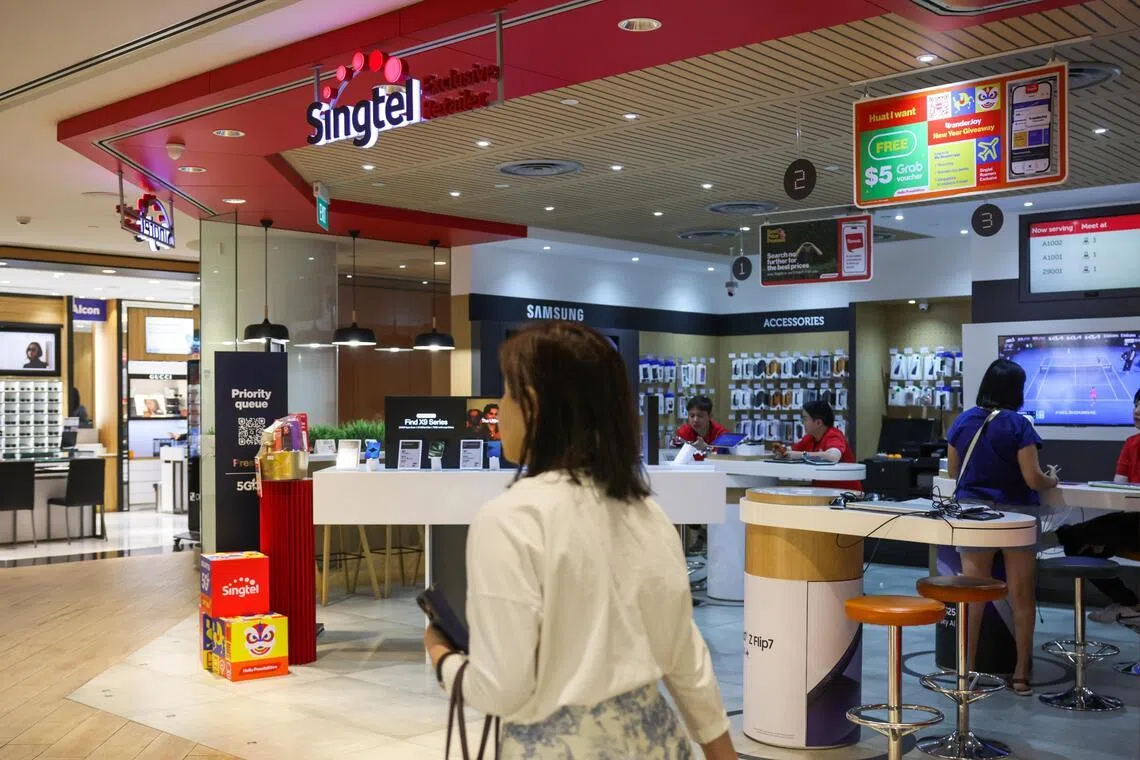
Singtel said that it protected its customers from potential scam calls and SMSes via firewalls with pattern recognition and machine learning capabilities.
ST PHOTO: GIN TAY
Benjamin Lim
Published Jun 30, 2026, 07:15 PM
Updated Jun 30, 2026, 11:01 PM
AI generated
SINGAPORE – Over 30 million voice calls and 20 million SMSes suspected to be scam calls and messages were blocked from reaching Singtel’s customers each month during the financial year that ended March 31, the telco said in its sustainability report released on June 30.
That works out to over 360 million voice calls and 240 million SMSes for the year.
Scam calls and SMSes have increased significantly as scam actors have become more sophisticated, said a Singtel spokesperson, and the telco has stepped up its scam mitigation measures in response.
It added that the average monthly figure for potential scam calls and SMSes blocked a year ago was around 10 million each.
According to Singtel, its customers were protected via advanced voice and SMS firewalls with capabilities such as pattern recognition, volumetric analysis and machine learning.
Official figures provided by the Infocomm Media Development Authority (IMDA) showed that over 260 million potential scam calls and 40 million potential scam SMSes were blocked in Singapore in 2025.
In 2024, there were 117 million potential scam calls and 50 million SMS messages blocked, IMDA said.
According to IMDA, the authorities partnered with telcos and the police to disrupt scams across various communication channels.
In addition to blocking potential scam calls and messages, it has also disrupted around 100,000 mobile lines suspected of misuse since mid-2024.
During the financial year, Singtel said it collaborated with IMDA and other organisations to raise digital literacy and scam awareness among seniors and other members of the public.
As a result, it noted, seniors who are usually less digitally savvy were more confident using their mobile devices and also more aware of online dangers such as scams, suspicious hyperlinks and making bank withdrawals at the request of strangers.
Engagement and education programmes tailored for migrant workers and domestic helpers were held during the financial year, given their increased exposure to job and loan scams.
Singtel also extended cybersecurity training programmes to local firms, and conducted artificial intelligence literacy workshops for primary school pupils during the financial year.
The telco’s information technology engineering subsidiary NCS developed an AI-powered phishing detection solution with the National University of Singapore. Using deep learning and multi-layered content analysis, it can assess whether a website genuinely belongs to the organisation it claims to represent.
Singtel said the tool increases the precision and efficiency of identifying malicious websites, processing around 100,000 suspicious URLs every day and reducing human effort by 85 per cent.
It added that the emergence of frontier AI models is greatly accelerating the speed and scale at which vulnerabilities can be discovered and exploited.
“This changes the pace and complexity at which organisations must detect and respond to such cyberthreats.”
Singtel
Telcos
Scams
E-paper
Newsletters
Podcasts
RSS Feed
About Us
Terms & Conditions
Personal Data Protection Notice
Need help? Reach us here.
Advertise with us

Over 50 million scam calls and SMSes blocked by Singtel each month in FY2026: Report – The Straits Times