
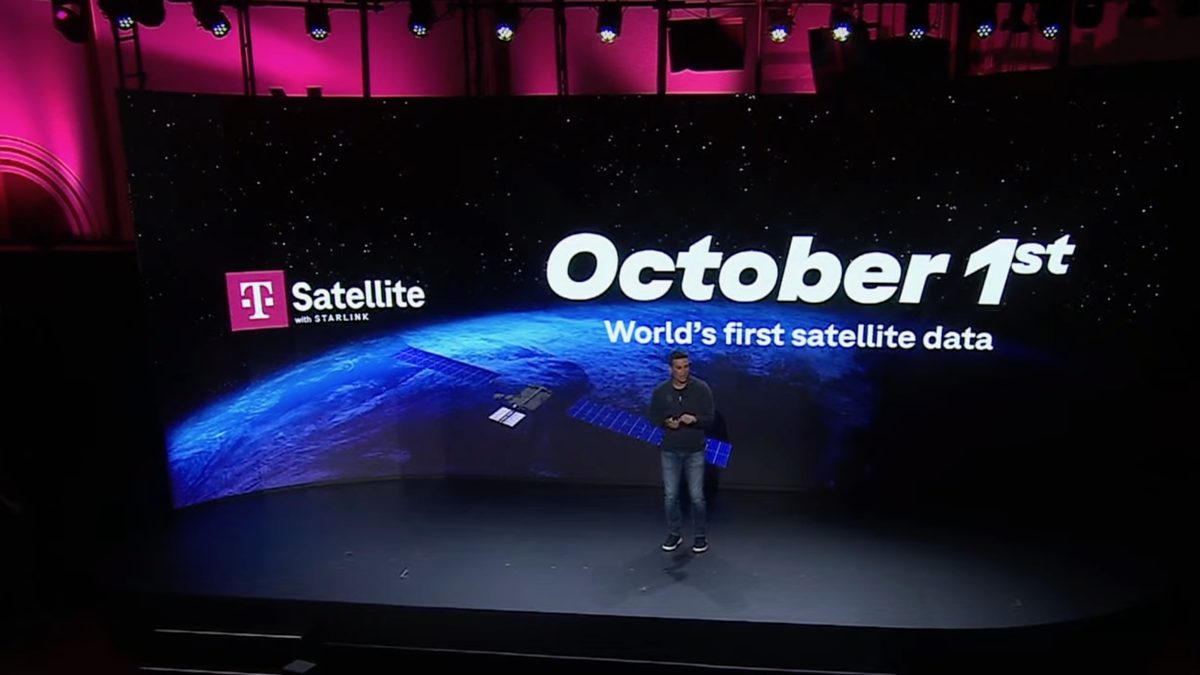

T-Mobile’s cellular Starlink service can already send satellite-based SMS messages from phones in mobile dead zones. But starting in October, it will add support for data in select third-party apps, including WhatsApp and X.
T-Mobile’s cellular Starlink service, known as T-Satellite, is currently available as a free beta, but officially launches on July 23, the carrier confirmed today. On that day, T-Mobile will also add MMS support (first on Android phones and later on iPhone), meaning users will be able to send images and audio clips in addition to the standard text messages.
On Oct. 1, the T-Satellite service will then receive the data support for a select group of third-party apps, including those from Google and Apple, along with AccuWeather and hiking guide app AllTrails. Eligible subscribers will be able use such apps in cellular dead zones by connecting to SpaceX’s orbiting satellites. The list of supported apps is bound to grow over time.
The carrier kicked off the beta for T-Satellite in January, initially recruiting T-Mobile customers before expanding it to users on rival carriers, including AT&T and Verizon, for free. Since then, T-Mobile says 1.8 million users have signed up to try the beta, the company revealed during a Monday live stream.
The technology automatically connects phones to the T-Satellite service once they travel to a rural or remote region without cellular service. The phone can then send and receive SMS messages via satellites, although sometimes the texts can take several minutes to transmit.
Although Apple also offers satellite messaging, it’s exclusive to iPhones. In contrast, T-Mobile’s service works on “over 60 different discrete devices,” according to the carrier’s marketing president, Mike Katz. The beta for T-Satellite was also able to “save lives,” he said, noting that dozens of customers sent 911-based SMS texts during the beta period.
T-Mobile and SpaceX also plan on offering support for voice and video calls, but it may require the companies to acquire more radio spectrum to improve the data transmission.
Once the beta ends next month, the T-Satellite service will cost $10 per month for users on T-Mobile and other carriers, including AT&T and Verizon, who can receive access through a secondary eSIM. T-Mobile subscribers on the carrier’s new Experience Beyond plan will receive the satellite feature as a free perk.
Still, the carrier plans on making the satellite service free for emergency uses. “Later this year, T-Satellite will provide 911 texting service to any mobile customer with a compatible device, regardless of carrier or whether or not they are subscribed to the service,” the company says.
T-Mobile also used Monday’s announcement to recruit third-party companies to make their apps compatible with the satellite service. “Any app developer interested in how to get their app optimized for satellite data can email [email protected],” the carrier says.
Read Our Editorial Mission Statement and Testing Methodologies.
My Experience
I’ve been a journalist for over 15 years. I got my start as a schools and cities reporter in Kansas City and joined PCMag in 2017, where I cover satellite internet services, cybersecurity, PC hardware, and more. I’m currently based in San Francisco, but previously spent over five years in China, covering the country’s technology sector.
Since 2020, I’ve covered the launch and explosive growth of SpaceX’s Starlink satellite internet service, writing 600+ stories on availability and feature launches, but also the regulatory battles over the expansion of satellite constellations, fights with rival providers like AST SpaceMobile and Amazon, and the effort to expand into satellite-based mobile service. I’ve combed through FCC filings for the latest news and driven to remote corners of California to test Starlink’s cellular service.
I also cover cyber threats, from ransomware gangs to the emergence of AI-based malware. Earlier this year, the FTC forced Avast to pay consumers $16.5 million for secretly harvesting and selling their personal information to third-party clients, as revealed in my joint investigation with Motherboard.
I also cover the PC graphics card market. Pandemic-era shortages led me to camp out in front of a Best Buy to get an RTX 3000. I’m now following how President Trump’s tariffs will affect the industry. I’m always eager to learn more, so please jump in the comments with feedback and send me tips.
Read full bio
PCMag is obsessed with culture and tech, offering smart, spirited coverage of the products and innovations that shape our connected lives and the digital trends that keep us talking.